Trace the input
Observe the actual convergence point during rain and mark the lowest usable inlet elevation.

Direct surface collection
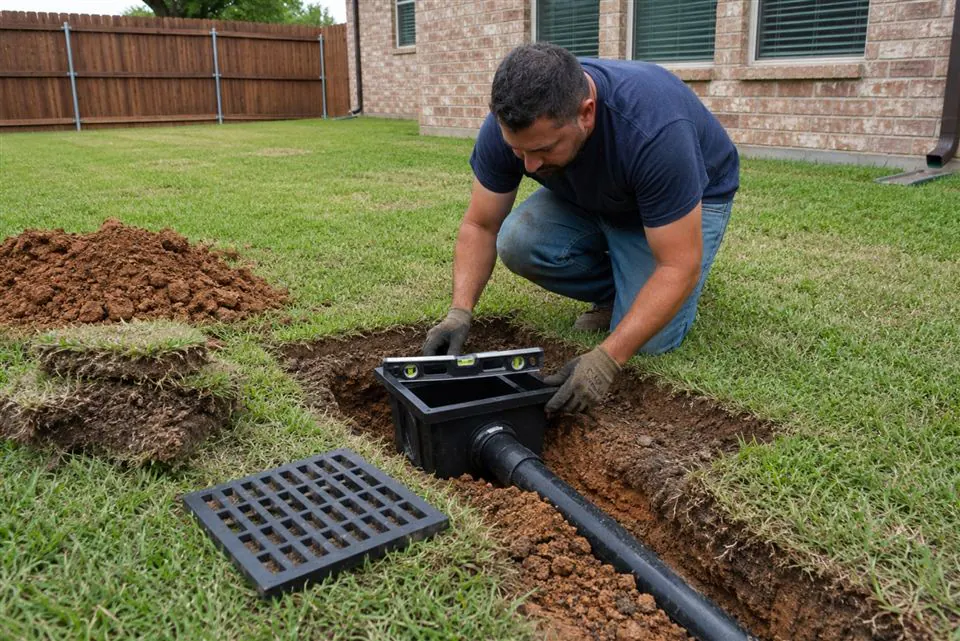
A properly located surface inlet captures runoff where it naturally concentrates, then sends it through solid pipe toward a verified outlet.
See the difference first
Before reading the technical details, compare the complete route with the shortcut that commonly fails.
Request This Assessment
Set the inlet at the true low elevation, give the surrounding surface positive fall to the grate and keep the outlet accessible for inspection.
An inlet placed slightly above the low point can look finished yet leave the water beside it, while a buried outlet can stop the entire system.
Generated educational comparison. It explains an installation principle and is not presented as a completed Texas Yard Drainage project.
A repeatable lawn, patio-edge or landscape low point that fills from surface runoff.
Broad saturated soil with no defined inlet point or no lower outlet for the pipe.
Where can the water go with continuous fall, safe discharge and practical maintenance access?
What this service means
A catch basin is the entry point for water that can be seen moving across the surface. It should sit where the puddle naturally forms, not where installation happens to be easiest.
The inlet rim elevation, contributing surface area, grate open area, sump configuration, solid conveyance pipe and downstream outlet determine performance. Finish grading must maintain positive fall to the grate without creating a trip or mowing problem.
How the work is planned
The materials are selected after the water source and physical route are understood.
Observe the actual convergence point during rain and mark the lowest usable inlet elevation.
Size and place the basin for the contributing surface area and expected debris.
Connect solid pipe with continuous fall to a protected, inspectable discharge point.
Shape and restore the surrounding surface so runoff reaches—not bypasses—the grate.
Catch Basins & Surface Drains in North Texas
Short intense storms can deliver water faster than compacted lawns absorb it. Leaves, oak debris and grass clippings also make reachable grates and outlets essential for routine maintenance.
Collection alone does not remove water. Gravity systems require a continuously lower, maintainable discharge point. Pumped systems require a protected pressure discharge and safe service access. In both cases, the destination must be confirmed before installation.
A useful scope identifies the input, collection point, material type, pipe or surface route, access constraints, outlet protection and restoration. It should also explain why this method fits better than the common alternatives.
Decision guide
| Observed condition | Direction to evaluate | Reason |
|---|---|---|
| Water arrives mainly from a downspout | Underground downspout drainage or source control | Keep concentrated roof water in a solid conveyance route. |
| Water collects at one visible low point | Surface inlet or limited regrading | Capture the water where it actually concentrates. |
| Broad runoff follows a shallow path | Grading or a swale | A stable surface route may be simpler than another buried pipe. |
| An existing drain once worked | Inspection, cleaning or repair | Locate the failed component before replacing the system. |
| No gravity outlet is physically available | Outdoor sump pump system | Collect water in a serviceable basin and pump it to a protected outlet only after elevations rule out gravity. |
Local drainage guidance
Use the city guide for local drainage context, then return to this central service page for system design, correct installation and failure patterns.
Each city guide combines the regional drainage method with verified local context, common property conditions and direct links to the relevant problem and service pages.
Catch Basins & Surface Drains FAQ
These answers are general. Final recommendations depend on the property, elevations, utilities and outlet.
The number depends on how runoff converges, the contributing area and the pipe route—not the yard size alone.
Leaves and grass can obstruct any surface inlet, so the grate and outlet need visible, reachable maintenance points.
The collection and conveyance roles should be designed deliberately. Concentrated surface water is commonly carried in solid pipe.
It should match the intended finish elevation while still remaining the collection low point.
Assessment first
Photos during or immediately after rain are especially useful.