Trace the input
Identify the source and measure how runoff becomes concentrated.

Stable surface drainage
Erosion indicates that water is moving with enough concentration or speed to carry soil. The plan should control the source and stabilize the route—not only refill the washed area.
See the difference first
Before reading the technical details, compare the complete route with the shortcut that commonly fails.
Request This Assessment
Reduce concentrated inputs where possible, establish a predictable route and use a stable surface or outlet transition matched to the flow.
Thin fill, loose mulch or an abrupt pipe outlet can wash out during the next storm and move the erosion farther downhill.
Generated educational comparison. It explains an installation principle and is not presented as a completed Texas Yard Drainage project.
Scoured soil below downspouts, bare channels on slopes and fence-line runoff carrying mulch or topsoil.
Loose rock placed on top of an active erosion path without controlling water volume, velocity or the downstream transition.
Where can the water go with continuous fall, safe discharge and practical maintenance access?
What this service means
Erosion is moving water carrying soil away. Refilling the hole does not last if the same amount of fast water still reaches the same unprotected route.
The design addresses source volume, velocity, slope, shear resistance, channel lining, stone gradation, geotextile separation and terminal scour protection. Outlet energy is spread before it reaches erodible soil.
How the work is planned
The materials are selected after the water source and physical route are understood.
Identify the source and measure how runoff becomes concentrated.
Reduce or redirect the input within a lawful serviceable route where possible.
Shape and line the flow path for expected velocity and soil conditions.
Protect the downstream transition and establish vegetation or permanent stabilization.
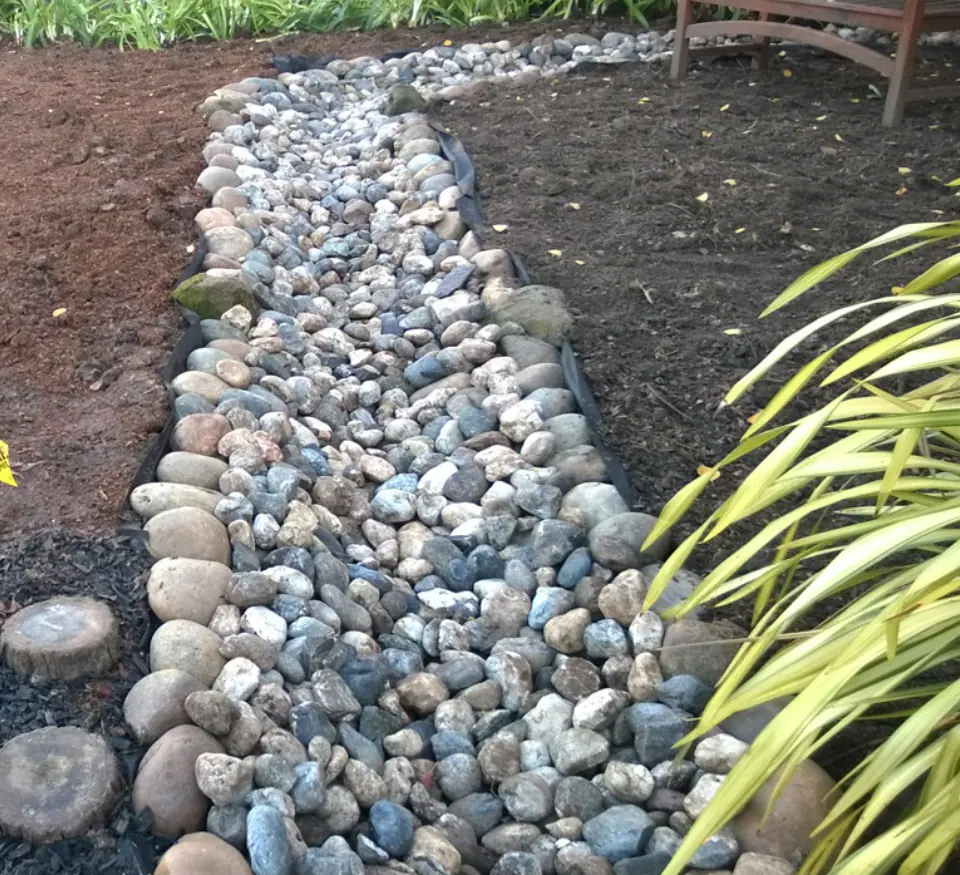
Erosion & Runoff Control in North Texas
Bare clay can seal at the surface and shed water rapidly, while newly disturbed soil is vulnerable before vegetation establishes. Downspout and pipe outlets are common locations for concentrated scour.
Collection alone does not remove water. Gravity systems require a continuously lower, maintainable discharge point. Pumped systems require a protected pressure discharge and safe service access. In both cases, the destination must be confirmed before installation.
A useful scope identifies the input, collection point, material type, pipe or surface route, access constraints, outlet protection and restoration. It should also explain why this method fits better than the common alternatives.
Decision guide
| Observed condition | Direction to evaluate | Reason |
|---|---|---|
| Water arrives mainly from a downspout | Underground downspout drainage or source control | Keep concentrated roof water in a solid conveyance route. |
| Water collects at one visible low point | Surface inlet or limited regrading | Capture the water where it actually concentrates. |
| Broad runoff follows a shallow path | Grading or a swale | A stable surface route may be simpler than another buried pipe. |
| An existing drain once worked | Inspection, cleaning or repair | Locate the failed component before replacing the system. |
| No gravity outlet is physically available | Outdoor sump pump system | Collect water in a serviceable basin and pump it to a protected outlet only after elevations rule out gravity. |
Local drainage guidance
Use the city guide for local drainage context, then return to this central service page for system design, correct installation and failure patterns.
Each city guide combines the regional drainage method with verified local context, common property conditions and direct links to the relevant problem and service pages.
Erosion & Runoff Control FAQ
These answers are general. Final recommendations depend on the property, elevations, utilities and outlet.
Only when stone size, depth, fabric, slope and the water transition are designed for the flow.
Established turf can help with shallow, non-erosive flow, but concentrated or fast runoff may need a stronger lining.
Blocking a path without a new outlet can deepen ponding or redirect water unpredictably.
Water leaving a pipe can be faster and more concentrated, so the discharge area must resist scour.
Assessment first
Photos during or immediately after rain are especially useful.