Trace the input
Confirm with elevations that a dependable gravity route is unavailable.

Pumped yard drainage
An outdoor sump pump collects water in a serviceable basin and lifts it through a pressure discharge line when the yard is too low for a dependable gravity outlet.
See the difference first
Before reading the technical details, compare the complete route with the shortcut that commonly fails.
Request This Assessment
Use a sealed outdoor basin, stable pump base, removable service lid, check valve, union, outdoor-rated controls and a solid discharge route to a protected approved outlet.
A pump buried in mud without a check valve, service access, weatherproof power or a remote discharge point can short-cycle, clog and send the same water back into the low area.
Generated educational comparison. It explains an installation principle and is not presented as a completed Texas Yard Drainage project.
Deep or enclosed low areas where surface collection is possible but measured elevations do not provide a continuous gravity route.
A loose pump in an open bucket, an indoor extension cord in wet soil or a hose that releases water where it immediately returns.
Where can the water go with continuous fall, safe discharge and practical maintenance access?
What this service means
An outdoor sump pump is used when water can be collected but the yard is lower than every dependable gravity outlet. The pump lifts the water; it does not eliminate the need for a complete collection and discharge route.
Design includes basin storage volume, pump curve and duty point, solids handling, float range, check valve, union, pressure discharge pipe, cycling rate, alarm or backup considerations, outdoor-rated controls and an approved terminal discharge.
How the work is planned
The materials are selected after the water source and physical route are understood.
Confirm with elevations that a dependable gravity route is unavailable.
Collect surface or subsurface water into a sealed, accessible outdoor basin.
Select pump, controls and basin volume for inflow and discharge head.
Install check valve, union, weatherproof power and solid pressure line to a protected outlet.
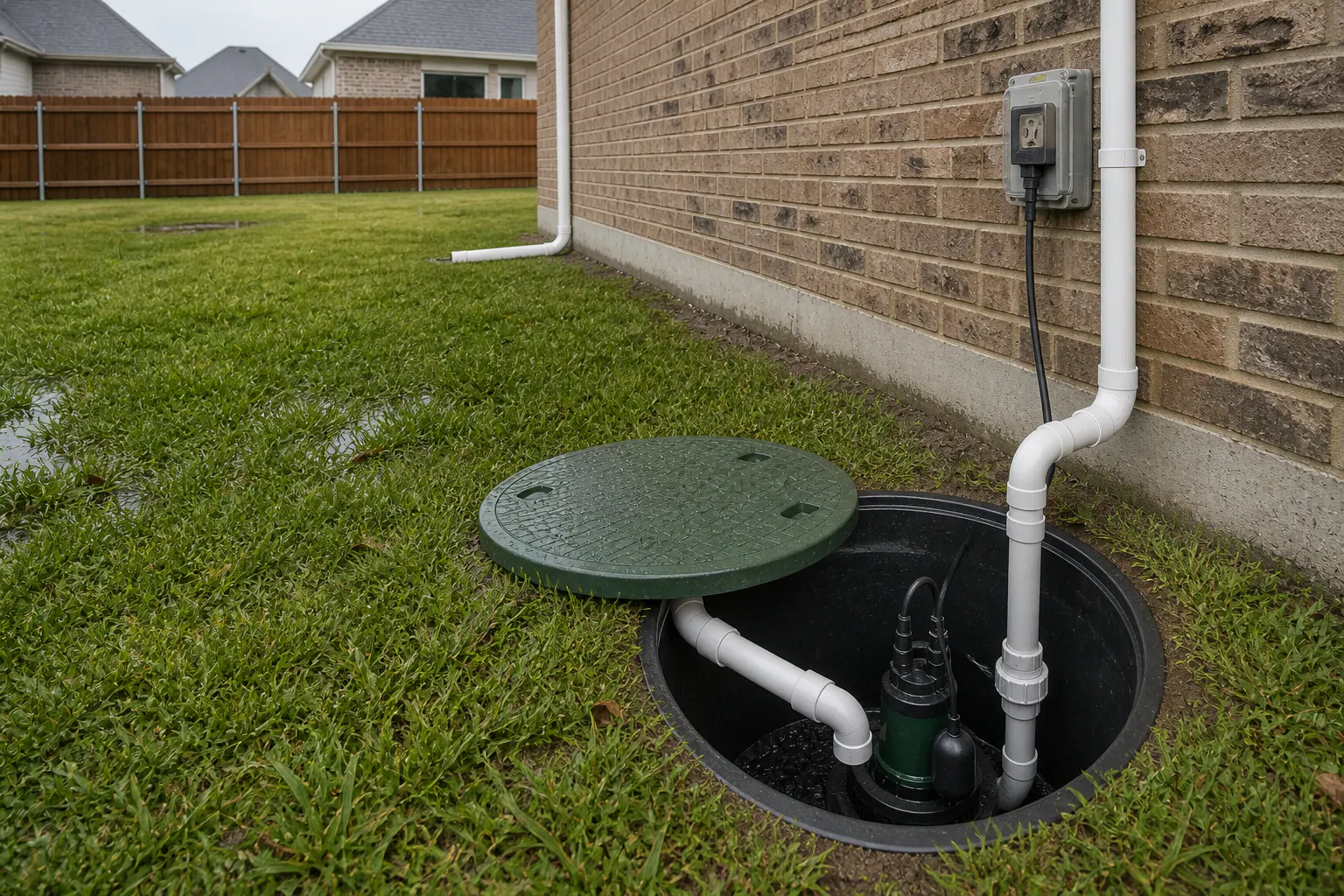
Outdoor Sump Pump Systems in North Texas
Short intense storms can fill a low basin quickly, so pump capacity cannot be selected by horsepower alone. Power outages, debris, freezing exposure, service access and where the pressure line releases are all part of reliability planning.
Collection alone does not remove water. Gravity systems require a continuously lower, maintainable discharge point. Pumped systems require a protected pressure discharge and safe service access. In both cases, the destination must be confirmed before installation.
A useful scope identifies the input, collection point, material type, pipe or surface route, access constraints, outlet protection and restoration. It should also explain why this method fits better than the common alternatives.
Decision guide
| Observed condition | Direction to evaluate | Reason |
|---|---|---|
| Water arrives mainly from a downspout | Underground downspout drainage or source control | Keep concentrated roof water in a solid conveyance route. |
| Water collects at one visible low point | Surface inlet or limited regrading | Capture the water where it actually concentrates. |
| Broad runoff follows a shallow path | Grading or a swale | A stable surface route may be simpler than another buried pipe. |
| An existing drain once worked | Inspection, cleaning or repair | Locate the failed component before replacing the system. |
| No gravity outlet is physically available | Outdoor sump pump system | Collect water in a serviceable basin and pump it to a protected outlet only after elevations rule out gravity. |
Local drainage guidance
Use the city guide for local drainage context, then return to this central service page for system design, correct installation and failure patterns.
Each city guide combines the regional drainage method with verified local context, common property conditions and direct links to the relevant problem and service pages.
Outdoor Sump Pump Systems FAQ
These answers are general. Final recommendations depend on the property, elevations, utilities and outlet.
It is considered after elevations show that gravity collection cannot reach a safe lower outlet.
No. A float control starts the pump as water rises in the basin; cycling frequency depends on inflow, basin volume and pump sizing.
The system cannot pump without power unless a specifically designed backup is included. Basin capacity, alarm options and emergency overflow planning should be discussed.
Outdoor power and controls should be installed or verified by the appropriately licensed electrical professional under applicable requirements.
Yes, a correctly oriented check valve helps prevent discharged water from draining back into the basin after the pump stops.
Assessment first
Photos during or immediately after rain are especially useful.