Trace the input
Review rain photos, recovery time and the history of the problem.
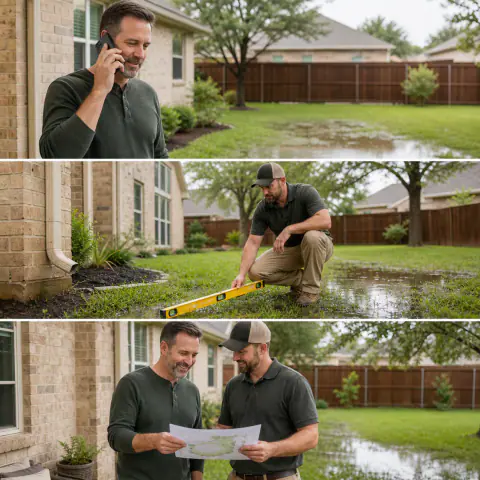
Diagnosis before estimate
A free property drainage assessment documents where water begins, how it crosses the yard and whether a practical outlet exists before a drainage estimate is prepared.
See the difference first
Before reading the technical details, compare the complete route with the shortcut that commonly fails.
Request This Assessment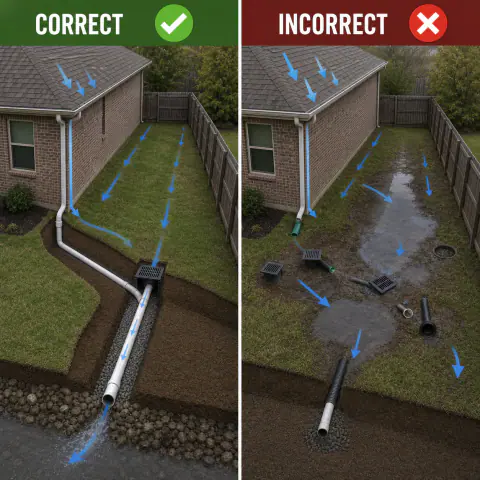
Review storm evidence, walk the property, identify roof and surface inputs, check soil and elevations, trace utilities and access, and outline the collection route and outlet in a clear visual plan.
Pricing a drain before the source and outlet are understood can produce an incomplete installation that moves the puddle without solving the drainage problem.
Generated educational comparison. It explains an installation principle and is not presented as a completed Texas Yard Drainage project.
Recurring standing water, wet foundation areas, soggy side yards or several possible water sources that need an on-site diagnosis.
A structural inspection, land survey, engineering report or guaranteed price based only on a photo or linear-foot guess.
Where can the water go with continuous fall, safe discharge and practical maintenance access?
What this service means
A property drainage assessment is the diagnostic visit before a system is selected. We look at what happens during rain, where the water comes from, which areas stay wet and where the property could safely release collected water. The goal is a practical explanation and visual plan—not a list of products.
The field review considers contributing roof and surface areas, inlet elevations, longitudinal fall, soil behavior, known utilities, constructability, pipe or swale routing, maintenance access and terminal discharge conditions. Measurements are appropriate to contractor planning and do not replace a boundary survey or sealed engineering design.
How the work is planned
The materials are selected after the water source and physical route are understood.
Review rain photos, recovery time and the history of the problem.
Walk the roof, hardscape, lawn and property edges to identify every likely input.
Check important elevations, access, utilities, soil clues and the proposed outlet route.
Provide a visual scope and drainage estimate when the project is within service and construction scope.
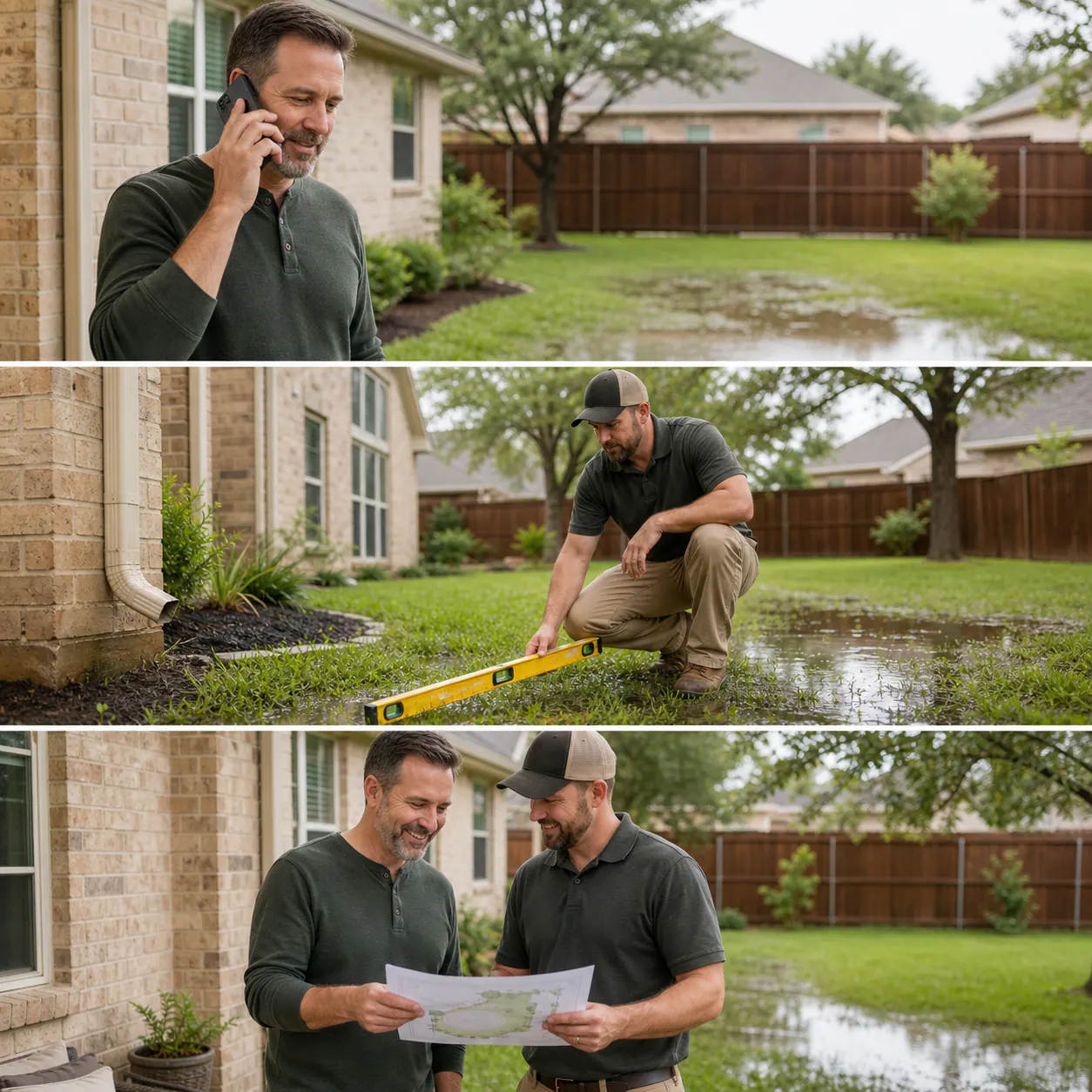
Property Drainage Assessment in North Texas
Dallas–Fort Worth properties often combine intense roof runoff, compacted construction soil and narrow side-yard grades. A free drainage assessment separates fast surface water from slow soil saturation so a catch basin, solid downspout pipe, French drain, channel drain, grading change or pump is recommended only when its role is clear.
Collection alone does not remove water. Gravity systems require a continuously lower, maintainable discharge point. Pumped systems require a protected pressure discharge and safe service access. In both cases, the destination must be confirmed before installation.
A useful scope identifies the input, collection point, material type, pipe or surface route, access constraints, outlet protection and restoration. It should also explain why this method fits better than the common alternatives.
Decision guide
| Observed condition | Direction to evaluate | Reason |
|---|---|---|
| Water arrives mainly from a downspout | Underground downspout drainage or source control | Keep concentrated roof water in a solid conveyance route. |
| Water collects at one visible low point | Surface inlet or limited regrading | Capture the water where it actually concentrates. |
| Broad runoff follows a shallow path | Grading or a swale | A stable surface route may be simpler than another buried pipe. |
| An existing drain once worked | Inspection, cleaning or repair | Locate the failed component before replacing the system. |
| No gravity outlet is physically available | Outdoor sump pump system | Collect water in a serviceable basin and pump it to a protected outlet only after elevations rule out gravity. |
Local drainage guidance
Use the city guide for local drainage context, then return to this central service page for system design, correct installation and failure patterns.
Each city guide combines the regional drainage method with verified local context, common property conditions and direct links to the relevant problem and service pages.
Property Drainage Assessment FAQ
These answers are general. Final recommendations depend on the property, elevations, utilities and outlet.
Yes. Texas Yard Drainage offers a free initial on-site assessment for eligible residential properties within the current Dallas–Fort Worth service area. Coverage and appointment availability are confirmed by address.
We review rain photos, walk the problem area, identify likely water sources, compare important elevations and evaluate a possible route and outlet.
When the project is within scope, the assessment is used to prepare a written estimate that explains the proposed collection method, route, outlet and principal assumptions.
No. It is a contractor drainage assessment. Surveying, engineering, structural, plumbing and legal questions require the appropriately qualified professional.
Photos or video taken during rain, the time water remains, known irrigation or utility locations and any history of previous drainage work are especially useful.
Assessment first
Photos during or immediately after rain are especially useful.