Trace the input
Measure existing elevations from the problem area to a stable lower destination.

Surface flow by elevation
Sometimes the simplest durable solution is reshaping a shallow path so runoff moves across a stable surface instead of entering another buried pipe.
See the difference first
Before reading the technical details, compare the complete route with the shortcut that commonly fails.
Request This Assessment
Verify elevations, create a continuous shallow fall and stabilize the finished surface so runoff follows the intended path without eroding it.
Moving soil by eye can create a new low spot, trap water at a fence or send concentrated runoff toward another property.
Generated educational comparison. It explains an installation principle and is not presented as a completed Texas Yard Drainage project.
Broad shallow runoff, minor low areas and yards where positive surface fall can reach an acceptable outlet.
Excavation that would direct water toward a neighbor, expose roots or utilities, or compromise the home’s required grade relationship.
Where can the water go with continuous fall, safe discharge and practical maintenance access?
What this service means
Grading changes the shape of the ground so water can keep moving on the surface. A swale is usually broad and shallow enough to remain mowable rather than looking like a trench.
Existing and proposed spot elevations define positive surface drainage, cross-slope, longitudinal fall and tie-in points. Finished grade must preserve foundation exposure, weep holes, utilities, tree roots and legal discharge constraints.
How the work is planned
The materials are selected after the water source and physical route are understood.
Measure existing elevations from the problem area to a stable lower destination.
Design a broad surface path that respects the home, fence, trees and neighboring property.
Place and compact suitable soil in controlled lifts where needed.
Stabilize with turf or erosion-resistant material and confirm flow after restoration.
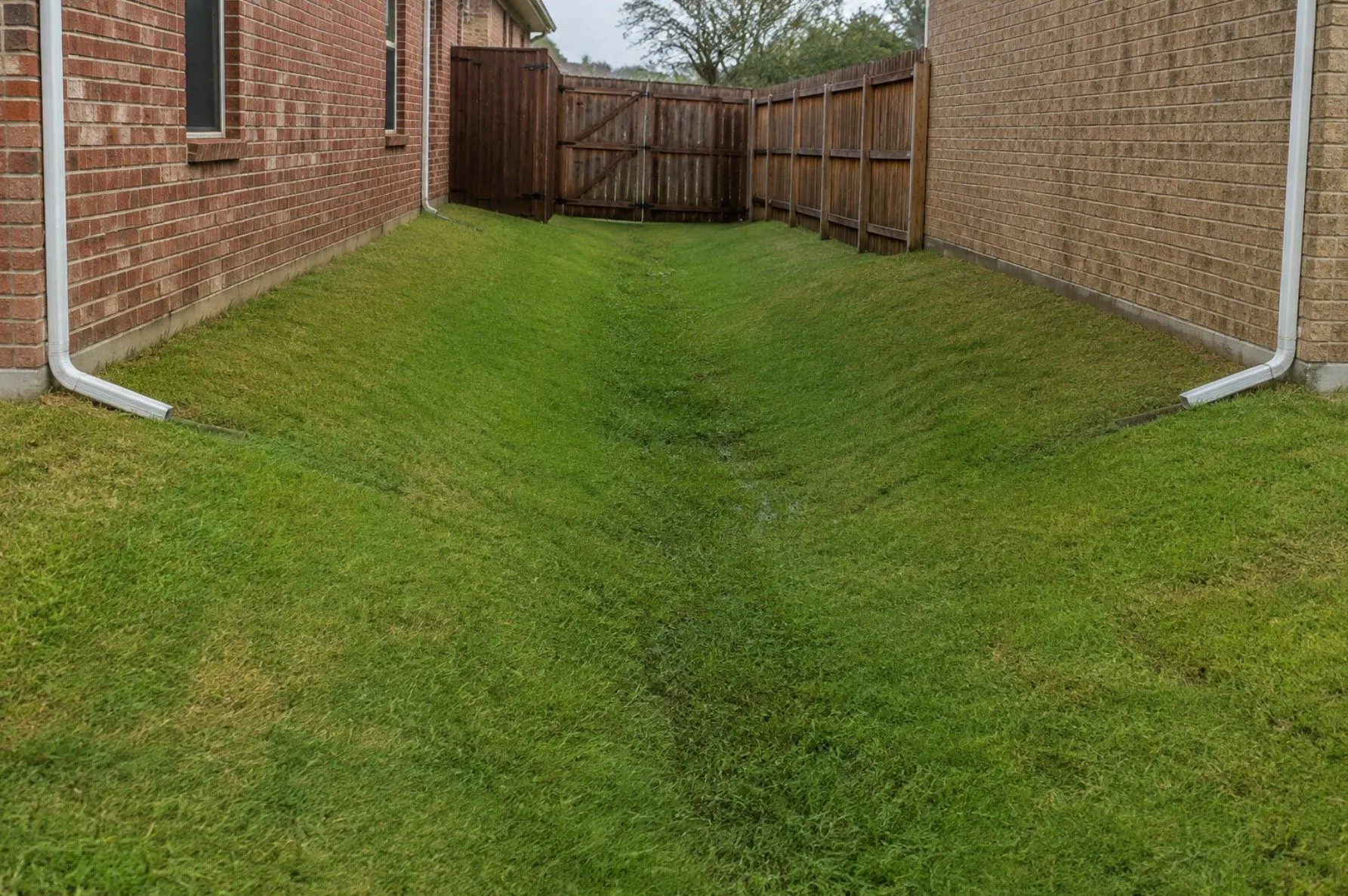
Yard Grading & Drainage Swales in North Texas
Clay soils expand, shrink and settle, so small low areas can return if fill is poorly placed or compacted. Turf establishment and erosion protection are part of the drainage work, not cosmetic afterthoughts.
Collection alone does not remove water. Gravity systems require a continuously lower, maintainable discharge point. Pumped systems require a protected pressure discharge and safe service access. In both cases, the destination must be confirmed before installation.
A useful scope identifies the input, collection point, material type, pipe or surface route, access constraints, outlet protection and restoration. It should also explain why this method fits better than the common alternatives.
Decision guide
| Observed condition | Direction to evaluate | Reason |
|---|---|---|
| Water arrives mainly from a downspout | Underground downspout drainage or source control | Keep concentrated roof water in a solid conveyance route. |
| Water collects at one visible low point | Surface inlet or limited regrading | Capture the water where it actually concentrates. |
| Broad runoff follows a shallow path | Grading or a swale | A stable surface route may be simpler than another buried pipe. |
| An existing drain once worked | Inspection, cleaning or repair | Locate the failed component before replacing the system. |
| No gravity outlet is physically available | Outdoor sump pump system | Collect water in a serviceable basin and pump it to a protected outlet only after elevations rule out gravity. |
Local drainage guidance
Use the city guide for local drainage context, then return to this central service page for system design, correct installation and failure patterns.
Each city guide combines the regional drainage method with verified local context, common property conditions and direct links to the relevant problem and service pages.
Yard Grading & Drainage Swales FAQ
These answers are general. Final recommendations depend on the property, elevations, utilities and outlet.
A swale can be broad and shallow; the required shape depends on elevation and flow.
Finish elevation must respect siding, weep holes, foundation exposure and drainage requirements.
Sod follows the surface below it. The grade has to be corrected before the finish is restored.
No. Tight sites or deep low points may still require collection and conveyance.
Assessment first
Photos during or immediately after rain are especially useful.