Keep the route open
How to Clean and Maintain Channel and Trench Drains in North Texas
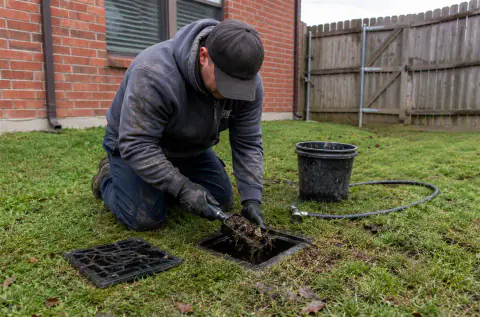
A channel or trench drain needs routine grate, trough, outlet and downstream-pipe inspection so leaves, silt and settlement do not turn a working system into a hidden reservoir.
Clean the grate before debris seals the openings, remove sediment from the channel without pushing it into the outlet, inspect joints and edge support, and confirm that test water reaches the terminal discharge. Repeated backups after cleaning can indicate a settled, damaged, undersized or poorly graded downstream route.
Reviewed September 9, 2026 · Dallas–Fort Worth homeowner guide
Timing
Inspect before seasonal storms and after heavy debris events
North Texas thunderstorms can move leaves, mulch, grass clippings and sediment quickly. Inspect the channel before forecast periods of heavy rain, after landscape work, and whenever runoff begins to bypass a section that previously captured water. Pool-deck and tree-lined drains may need more frequent attention than an open driveway crossing.
Do not wait for the entire grate to disappear under debris. A partial blockage changes how water approaches and can send sheet flow around the ends or toward a threshold.
Step by step
Clean from the inlet toward a known outlet
- Keep people and vehicles away from the work area and follow the manufacturer’s grate-removal method.
- Lift only serviceable sections; do not force corroded or damaged hardware.
- Scoop leaves, mulch and sediment from the channel instead of flushing a heavy mass into the outlet.
- Check joints, end caps, locking parts and visible concrete edges.
- Run a controlled amount of clean water and observe the terminal outlet.
- Replace and secure the grate, then record any slow section or movement.
Never enter a drainage structure or use equipment beyond its instructions. Unknown buried lines, confined spaces and electrical or pool-adjacent conditions require appropriate professionals.
Warning signs
A clean grate does not prove the system is healthy
- Water remains in one channel section after the rest drains.
- The grate rocks, bends or sits above the concrete edge.
- Concrete is cracked or hollow beside the channel.
- Water leaks from a joint and washes soil from below.
- No flow appears at the expected outlet.
- Sediment returns quickly after every cleaning.
- Runoff bypasses one or both ends during ordinary rain.
These signs can point to loss of support, poor grade, damaged joints, undersized conveyance or an outlet problem—not just routine debris.
Decision point
Know when cleaning should become a repair assessment
Cleaning is appropriate when the drain previously worked, the grate and channel remain stable, and debris is the isolated restriction. Repair may be needed when the channel has settled, an outlet fitting has separated, the downstream pipe holds water, concrete edges fail or the system never had adequate length or capacity.
Before replacing everything, locate the outlet and test individual sections. A targeted repair can preserve a usable route; repeated cleaning cannot create positive fall or add a missing discharge point. See drainage repair and cleaning for the diagnosis process.
Useful evidence
Keep a simple record of performance
Take one wide photo during rain, one close photo of the grate, one photo of the outlet and another image after cleaning. Note the storm date, which sections filled first and how long water remained. These records help distinguish a sudden blockage from a capacity or settlement issue.
If excavation becomes necessary, request utility locates through Texas 811 and verify private lines that the public locate may not identify.
Sources and further reading
- NDS — Pro Series Channel Drain Installation Instructions
- ACO USA — Commercial Trench Drains and Load Classes
- City of Dallas — Street and Drainage Design Manuals
- Texas 811 — Request Utility Locates Before Excavation
External sources support homeowner education and do not imply endorsement of Texas Yard Drainage. This guide is general information, not an engineering report or a property-specific design.
Continue the topic
Related drainage guides and problem pages
Homeowner FAQ
Questions this guide should answer
These answers help with early diagnosis. Actual recommendations still depend on the property.
How often should a channel drain be cleaned?
Inspect it before heavy-rain periods and after storms or landscape work that move debris. Actual cleaning frequency depends on trees, mulch, traffic and the drain location.
Can I flush debris into the outlet pipe?
Remove bulk debris first. Pushing leaves and sediment downstream can create a harder-to-reach obstruction.
Why is my trench drain still full after cleaning?
The downstream pipe may be blocked, flat, damaged or discharged to a high or submerged outlet; the channel itself may also have settled.
Should a channel drain always be dry?
A small residual film may depend on the product, but a section holding substantial water can indicate grade, debris or outlet problems.
Can a broken grate be replaced by any grate of the same width?
No. Compatibility, locking method, opening pattern and load rating should match the installed channel and use.
Need a property-specific answer?
Find the failed component before replacing the entire drain.
Texas Yard Drainage can evaluate accessible residential channel, pipe and outlet routes across DFW.
Request a Drainage Assessment