Garage and driveway interception
Concrete Driveway Channel Drains in Dallas: Installation Planning Guide
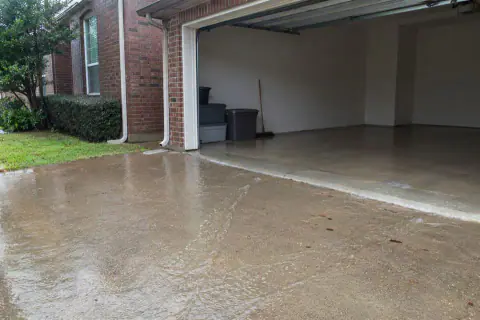
Plan a concrete driveway channel drain by the runoff width, surface elevations, vehicle load, concrete support, outlet pipe and terminal discharge.
A driveway channel drain should cross the complete path of runoff before water reaches the garage or another low hardscape area. The channel and grate must be suitable for expected vehicles, set into a supporting installation detail and connected to a solid pipe with capacity and usable fall to a verified outlet.
Reviewed September 9, 2026 · Dallas–Fort Worth homeowner guide
Runoff first
A driveway drain must cross the water, not merely sit near it
Driveway runoff often behaves as shallow sheet flow. Chalk marks, videos and photos during rain can show whether water approaches from the street, upper driveway, side yard or roof. The channel should extend beyond the active wet width so water does not bypass either end. A point drain at the center may miss flow spread across the entire slab.
Searches for channel drain Dallas TX or concrete drain grate Dallas TX often focus on the visible hardware. The decisive information is the surface elevation on both sides of that hardware and the location of a lower outlet.
Structural installation
The concrete around the channel keeps it aligned under traffic
Manufacturer details vary by channel series and load application. A retrofit may require saw cutting, removal of a strip of concrete, excavation, channel alignment, outlet connection, anchoring or suspension, and placement of new supporting concrete. The final surface must lead to the grate while keeping the channel edge stable.
Vehicle loading includes more than the car’s total weight. Wheel position, turning, braking and repeated crossings affect the grate and edge. The selected assembly should have published application guidance rather than an unsupported “heavy duty” description.
Hydraulic route
The downstream pipe and outlet can limit the entire driveway drain
The contributing driveway, roof or adjacent hardscape area determines how much runoff approaches. Intake passes through the grate into the channel; water then exits through an end, bottom outlet or catch point. Fittings, solid pipe, fall and discharge protection must carry that flow without simply moving the backup downstream.
If the only available outlet is higher than the channel invert, gravity will not create the required route. An alternate surface plan or designed pumped solution may need evaluation. A new grate cannot make water move uphill.
Existing conditions
Retrofit work should expose uncertainties before the final scope
- Confirm slab thickness and avoid claiming structural conditions from the surface alone.
- Locate utilities and private irrigation or electrical lines.
- Identify whether an existing pipe is usable and where it ends.
- Protect the garage, door seals and adjacent finishes during work.
- Plan concrete color and texture expectations for the repaired strip.
- Keep removable grate sections accessible after installation.
Compare proposals
A concrete channel-drain estimate should describe more than linear feet
Look for the channel manufacturer and model, grate material and rating, drain length, concrete demolition and replacement, outlet fitting, solid-pipe route, cleanout or access, terminal discharge and restoration. Exclusions should mention concealed reinforcement, utilities, unsuitable existing pipe and conditions that change the outlet.
See the current Dallas–Fort Worth yard drainage cost guide for planning ranges, then use a property assessment for the actual scope.
Sources and further reading
- NDS — Pro Series Channel Drain Installation Instructions
- ACO USA — Commercial Trench Drains and Load Classes
- City of Dallas — Street and Drainage Design Manuals
- Texas 811 — Request Utility Locates Before Excavation
External sources support homeowner education and do not imply endorsement of Texas Yard Drainage. This guide is general information, not an engineering report or a property-specific design.
Continue the topic
Related drainage guides and problem pages
Homeowner FAQ
Questions this guide should answer
These answers help with early diagnosis. Actual recommendations still depend on the property.
How long should a driveway channel drain be?
Long enough to extend across the complete active flow path, with end coverage so runoff cannot simply pass around it.
Can a residential channel drain handle cars?
Only when the grate, channel body, edge and supporting installation are rated and built for the expected vehicle use.
Will a concrete drain grate stop garage flooding?
It can intercept driveway sheet flow if placed before the threshold and connected to a route with enough capacity and a workable outlet.
Can a channel drain connect to an existing pipe?
Only after the pipe size, condition, fall, ownership and outlet are verified.
Why does water remain inside the channel?
Possible causes include a flat or obstructed outlet line, debris, settlement, insufficient internal fall or a terminal outlet that is submerged or too high.
Need a property-specific answer?
Design the driveway crossing from surface flow to outlet.
Request a free on-site assessment and visual plan for a qualifying DFW property.
Request a Free Assessment