Protect the house perimeter
How to Drain Water Away From Your House in North Texas
A practical DFW homeowner guide to downspouts, positive grading, catch basins, solid pipe, French drains and safe outlets around a house.
Start with the source. Keep roof water contained, maintain positive surface grade away from the house and provide a continuous route to a stable, lawful outlet. Use a catch basin for a true surface low point, solid pipe for concentrated roof or inlet water, and a French drain only when water is moving through saturated soil.
Reviewed September 14, 2026 · Dallas–Fort Worth homeowner guide
Read the evidence
Standing water beside the house means the source or exit route is not working
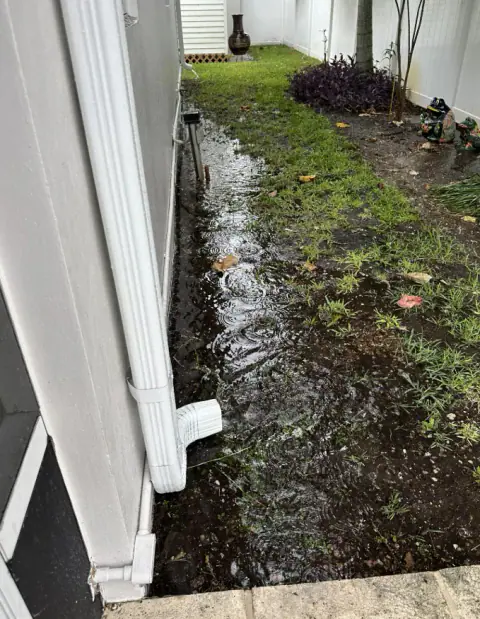
Water should not repeatedly remain against the slab, crawl-space edge, garage threshold or lower wall after ordinary rain. Look for a dark wet strip, eroded soil below a roof valley, mulch floating out of a bed, algae on concrete, soft turf or a puddle that grows from the house outward.
The location alone does not identify the correct drain. Water can arrive from a downspout, flow back across a reverse grade, cross from an uphill hard surface or remain in compacted soil after the visible runoff has stopped. Record where it first appears and how long it remains.
Exterior drainage can reduce recurring rainwater at the perimeter, but it does not repair a plumbing leak, waterproofing failure or structural movement. Those conditions require the appropriate qualified professional.
First priority
Control roof runoff before adding more yard drains
A roof collects a large area of rain and concentrates it at a few downspouts. If an elbow releases beside the wall, extending or burying that water in a solid downspout line may remove the highest-volume input.
Check that gutters are clear, downspouts are connected and roof valleys are not overshooting the gutter. A buried line should have serviceable transitions, continuous usable fall and a visible or reachable outlet. Do not connect roof water to perforated French-drain pipe simply because both routes are underground; conveyance and soil collection perform different jobs.
Keep water moving
Positive grade and a broad swale can restore the surface route
Ground beside the home should direct ordinary surface runoff away from the wall without covering required foundation exposure, siding clearances or brick weep holes. Measure the surface instead of judging by eye. A shallow low section, edging, patio addition or settled backfill can reverse the route.
Where space and elevation allow, grading or a broad drainage swale may be simpler and easier to maintain than buried pipe. The new grade must connect to somewhere lower. Filling the puddle without confirming that destination can shift water toward a door, fence or neighboring property.
Match the method
Catch basins, solid pipe and French drains solve different pathways
| Observed pathway | Method to evaluate | Key requirement |
|---|---|---|
| Surface runoff collects in one low point | Catch basin and solid pipe | The grate sits at the true finish low point |
| Roof water leaves a downspout | Solid underground downspout pipe | Serviceable connection and continuous fall |
| Broad shallow surface flow | Grading or swale | A stable lower surface route |
| Water moves through saturated soil | French drain | Fabric, clean aggregate, perforated pipe and outlet |
| Runoff crosses concrete | Channel or trench drain | Full flow-width interception and supported grate |
| No gravity outlet exists | Outdoor sump pump system | Safe power, service access and protected discharge |
A complete design can combine methods, but only after their flows and downstream capacity are checked together. More grates do not help when the pipe or outlet is the bottleneck.
Design backward
Confirm the final outlet before excavating the route
Every collected gallon needs a destination. Verify the outlet elevation, ownership, erosion resistance, maintenance access and local requirements. A curb, street, storm inlet, creek, neighbor or public easement is not an automatic private discharge right.
The pipe end should not be buried by sod or mulch, submerged in the same storm or aimed at loose soil that will wash away. If gravity cannot reach a workable lower point, compare another route or a properly designed pump rather than creating a flat buried line that holds water and debris.
Assessment and estimate
Call for help when the route is unclear or the house is at risk
An on-site property drainage assessment is useful when water reaches the foundation, enters a garage, crosses property lines, returns after previous drainage work or appears to have several sources. Photos during rain help, but elevations, utilities, access and outlet conditions must be checked on the property.
A drainage estimate should describe the diagnosis, collection points, pipe or grading route, outlet, materials, restoration and exclusions. Before excavation, contact Texas 811 and identify private irrigation, lighting, pool and electrical lines that the public utility locate may not mark.
Sources and further reading
- City of Fort Worth — Private Lot Drainage Review
- City of Dallas — Drainage Design Standards
- EPA — Soak Up the Rain: Disconnect / Redirect Downspouts
- FEMA — Protect Your Property From Flooding
- Texas 811 — Before You Dig
External sources support homeowner education and do not imply endorsement of Texas Yard Drainage. This guide is general information, not an engineering report or a property-specific design.
Continue the topic
Related drainage guides and problem pages
Homeowner FAQ
Questions this guide should answer
These answers help with early diagnosis. Actual recommendations still depend on the property.
What is the fastest way to move rainwater away from a house?
Start by correcting concentrated roof runoff and obvious reverse grade. The final method depends on a continuous route to a lower, stable outlet.
Should I install a French drain around the foundation?
Not automatically. A French drain is for water moving through saturated soil. Roof runoff and surface water may need solid pipe, a catch basin or grading instead.
Can I add topsoil beside the house?
Only after checking required clearances and confirming where displaced water will go. Never cover siding, weep holes or other drainage features.
How far should a downspout drain extend?
Distance alone is not the target. The line should reach a stable lower discharge point without sags, backup or adverse impact.
Why does water return after a drain was installed?
The inlet may miss the low point, the pipe may be flat or blocked, the outlet may be buried or the original water source may remain uncontrolled.
Is a property drainage assessment the same as an engineering report?
No. A contractor assessment supports practical drainage planning and estimating. Survey, engineering, structural and legal determinations require the appropriate professional.
Need a property-specific answer?
Find the water source before choosing the drain.
Request a free initial property drainage assessment for an eligible Dallas–Fort Worth residential address.
Request a Free Assessment