Linear drain terminology
Trench Drain vs. Channel Drain: What Dallas Homeowners Should Know
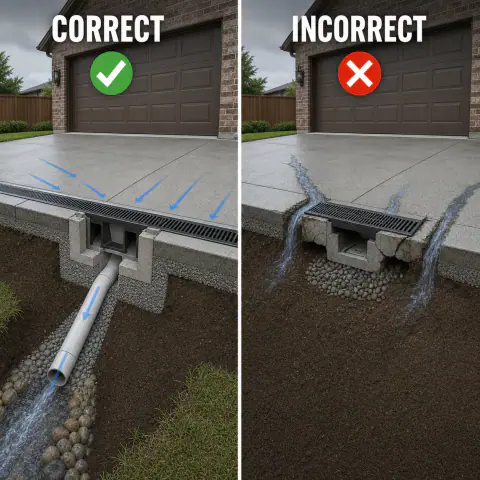
Trench drain and channel drain often describe the same linear surface-drainage concept, but product depth, width, grate strength, bedding and outlet design determine where a system can work.
In residential use, “trench drain” and “channel drain” are often used interchangeably for a long, narrow inlet that intercepts sheet flow across concrete, pavers or another hard surface. The name alone does not select the product. The contributing area, flow-line width, vehicle or pedestrian load, channel invert and downstream outlet must be checked together.
Reviewed September 9, 2026 · Dallas–Fort Worth homeowner guide
Plain-language answer
Trench drain and channel drain usually refer to the same collection idea
A channel drain is a manufactured linear channel covered by a removable grate. The term trench drain can refer to that same modular product or to a formed drain built within a trench. Search terms such as trench drains Dallas TX and channel drains Dallas TX often lead to the same residential need: stop a sheet of runoff before it crosses a garage opening, patio door, pool deck or driveway low line.
The useful distinction is not the wording. It is the installed assembly. A shallow plastic channel beside a patio does not have the same structure, intake or load capacity as a concrete-encased driveway system. Product width, channel depth, grate material and support should be selected only after the flow path and traffic are known.
Best-fit locations
A linear drain belongs across a predictable line of surface flow
Good candidate
Runoff approaches across a hard surface in a repeatable direction and can be intercepted before a garage, door, gate or lower paved area.
Poor candidate
Water is scattered across a lawn, remains in saturated soil or has no lower outlet after entering the channel.
The drain should normally extend beyond the active flow width so water cannot pass around either end. Its top elevation must accept water from the finished surface without creating an unsafe lip. A pool trench drain, driveway channel drain and patio drain may look similar, but each has different traffic, debris and surface-detail requirements.
Complete system
Grate intake is only the first capacity check
Water must pass through the grate, move inside the channel, enter an outlet fitting or catch basin, travel through solid pipe and discharge at a stable lower point. A larger grate cannot correct a flat downstream pipe or an outlet that sits too high. Likewise, a properly sloped pipe cannot help if the channel is above the approaching sheet flow.
Manufacturer instructions commonly address alignment, anchoring, joint connection and concrete or other bedding by application. The surrounding surface supports the channel and controls whether the grate remains flush after vehicle loads, soil movement and temperature changes. The exact installation detail should follow the selected system rather than a generic trench-drain sketch.
Failure patterns
Why a new channel drain can still leave standing water
- The drain stops short of one edge of the flow path.
- The concrete finish creates a ridge just before the grate.
- The grate or channel is not rated for the expected wheel load.
- Channel joints or the outlet connection leak into unsupported soil.
- The outlet pipe is too small, flat, crushed or already obstructed.
- No removable access remains for leaves, silt and pool-deck debris.
A useful proposal identifies the exact channel, grate, bedding, outlet connection, solid-pipe route and terminal discharge instead of quoting only a length of trench.
Local search intent
What to ask a Dallas trench-drain contractor
For a Dallas or Dallas–Fort Worth property, ask the contractor to show the contributing surface, active flow line and proposed outlet on a visual plan. If the drain crosses a driveway, ask for the stated load classification and concrete installation detail. If it is near a pool or walkway, ask about barefoot comfort, slip resistance, opening size and cleaning access.
Excavation can encounter electric, communications, irrigation, gas or other buried facilities. Request utility locates through Texas 811 before digging, and verify any city, HOA, easement or discharge requirements that apply to the address. The central channel and trench drain installation page explains how Texas Yard Drainage evaluates the complete route.
Sources and further reading
- NDS — Pro Series Channel Drain Installation Instructions
- ACO USA — Commercial Trench Drains and Load Classes
- City of Dallas — Street and Drainage Design Manuals
- Texas 811 — Request Utility Locates Before Excavation
External sources support homeowner education and do not imply endorsement of Texas Yard Drainage. This guide is general information, not an engineering report or a property-specific design.
Continue the topic
Related drainage guides and problem pages
Homeowner FAQ
Questions this guide should answer
These answers help with early diagnosis. Actual recommendations still depend on the property.
Is a trench drain the same as a channel drain?
In many residential conversations the terms are used for the same linear grated drain. Product construction, capacity, support and load rating matter more than the label.
Can a channel drain stop water entering a garage?
It can intercept a defined sheet-flow path before the threshold when it spans the full path and has sufficient downstream capacity and a usable outlet.
Can a trench drain be installed in grass?
A linear drain normally needs a stable edge and is best suited to hardscape. A lawn low point may be better served by grading or a catch basin.
Does the channel itself need slope?
Some systems have built-in slope and others are constant depth. In every case, the complete route must release water through a workable outlet.
Who should locate utilities before installation?
A locate request should be submitted through Texas 811 before excavation. Private lines may require additional locating.
Need a property-specific answer?
Confirm the flow line before cutting concrete.
Texas Yard Drainage provides free on-site assessment and a visual source-to-outlet plan for qualifying Dallas–Fort Worth properties.
Request a Free Assessment