Scope before price
How Yard Drainage Estimates Are Calculated in Dallas–Fort Worth
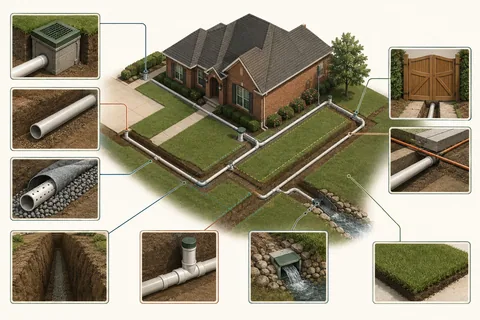
See how a property drainage assessment becomes a Dallas–Fort Worth drainage estimate based on diagnosis, measurements, access, outlet construction and restoration.
A drainage estimate should begin with a property drainage assessment and a complete source-to-outlet route. Quantities come from pipe length and diameter, inlet count, trench depth, aggregate volume, fittings, excavation, haul-off, hardscape work, outlet protection and restoration. Unknown conditions and exclusions should be written down.
Reviewed September 14, 2026 · Dallas–Fort Worth homeowner guide
Before the math
A price is meaningful only when the route is defined
Two projects with the same pipe length can have very different costs. One may cross open lawn to an existing gravity outlet; another may pass utilities, roots and concrete before reaching a pumped discharge.
A useful estimate begins with a property drainage assessment and states the source, collection method, conveyance route and outlet. It should separate an optional upgrade from work required for the proposed system to function.
Measured components
What is normally counted
| Quantity | Typical unit | Why it matters |
|---|---|---|
| Pipe | Linear feet by type and diameter | Material, fittings, trench width and capacity |
| Basins and cleanouts | Each | Excavation, connections and service access |
| Aggregate and fabric | Cubic yards / square feet | French-drain cross-section and delivery |
| Excavation and spoil | Length, width and depth | Labor, access, haul-off and replacement soil |
| Restoration | Square feet | Concrete, turf and finish expectations |
See current planning ranges in the DFW drainage cost guide. Site measurements control an actual quote.
Site conditions
Labor, access and the outlet often change price most
Depth, narrow access, wet clay, roots, buried debris, fence removal, utility conflicts and disposal can dominate the budget. Commercial work may require traffic control, load-rated grates, engineering or municipal review.
The outlet may require a pop-up emitter, stabilized daylight transition, pump basin, electrical work, detention or an approved connection. A cheap upstream component does not create a complete route.
Apples-to-apples review
How to compare proposals
- Confirm the same problem and design assumptions.
- Compare pipe material, diameter and solid versus perforated use.
- Verify trench dimensions and aggregate specification.
- Locate every inlet, cleanout and outlet on a sketch.
- Check concrete, irrigation, turf, haul-off and permit allowances.
- Read warranty scope and maintenance obligations.
A lower price may reflect smaller pipe, omitted restoration or an undefined outlet—not necessarily better value.
Written boundaries
Unknown conditions and change orders
An estimate cannot reveal every buried condition. It should explain how concealed utilities, rock, undocumented concrete, unsuitable soil, groundwater, owner changes and municipal requirements are handled.
Texas 811 advises contacting the service at least two business days before digging; private facilities may need separate location. Final price and schedule belong in a written agreement, not an educational web range.
Sources and further reading
- Texas 811 — Frequently Asked Questions
- City of Fort Worth — Private Lot Drainage Review
- City of Dallas — Drainage Design Standards
- EPA — Green Infrastructure Types
External sources support homeowner education and do not imply endorsement of Texas Yard Drainage. This guide is general information, not an engineering report or a property-specific design.
Continue the topic
Related drainage guides and problem pages
Homeowner FAQ
Questions this guide should answer
These answers help with early diagnosis. Actual recommendations still depend on the property.
Why is installation more expensive than pipe?
It includes diagnosis, layout, excavation, fittings, aggregate, handling, outlet construction, testing, cleanup and restoration.
Is drainage priced by linear foot?
Linear-foot ranges help planning, but final cost also depends on depth, components, access, outlet and restoration.
Should an estimate include the outlet?
Yes. Collection without a defined downstream route and stable discharge is incomplete.
Why do two bids differ so much?
They may use different diagnoses, pipe sizes, trench sections, restoration allowances or exclusions.
Can cost change after digging?
It can when concealed conditions fall within written exclusions. A clear change-order process should explain authorization and pricing.
Is the initial drainage assessment free?
Texas Yard Drainage offers a free initial on-site assessment for eligible residential addresses in its current DFW service area. A detailed survey, engineering design or specialty inspection is separate.
Need a property-specific answer?
Start with a free property drainage assessment.
Show us where water appears so the estimate can describe a complete source-to-outlet route.
Request a Free Assessment