Finish the route
Yard Drainage Outlets and Discharge Options in Dallas–Fort Worth
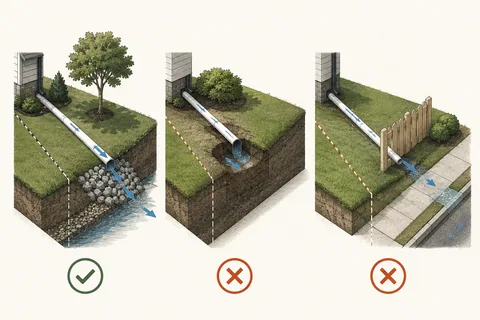
A drainage outlet is the final destination of collected water. It must be lower or mechanically served, stable, maintainable, lawful and unable to create a new problem downstream.
Common options include daylight to a stable lower area, a pop-up emitter, an approved curb or storm connection, a designed pump discharge, or site-specific infiltration and detention. The correct outlet depends on elevations, ownership, erosion risk, utilities and municipal requirements.
Reviewed September 9, 2026 · Dallas–Fort Worth homeowner guide
The downstream answer
A drain is incomplete until the destination is verified
Basins and trenches only collect water. Pipe only conveys it. If the outlet is too high, blocked, undersized or prohibited, water remains in the system and backs up at the property.
Measure the outlet under realistic conditions and inspect what lies beyond it. “Toward the street” is not an outlet description unless the transition, ownership and local permission are known.
Use elevation when available
Daylight, pop-up emitters and approved connections
| Outlet | Best use | Main check |
|---|---|---|
| Daylight | Pipe opens at a stable lower grade | Erosion, mowing and animal protection |
| Pop-up emitter | Low-profile release in a lower lawn area | Residual water, debris and surface spread |
| Curb discharge | Where municipality expressly permits a curb connection | Permit, pavement work and public right-of-way |
| Storm connection | Approved private or public system | Ownership, elevation, capacity and backflow |
A gravity line requires continuous fall. Learn to verify it in How to Calculate Yard Slope.
When gravity is unavailable
Outdoor sump pumping needs power, controls and service access
A pump can lift water from a low collection basin to a permitted higher discharge. The design must consider inflow, storage, pump curve, check valve, power, weather protection, alarm or backup strategy and a pressure-rated line.
An outdoor sump pump adds maintenance and failure modes. It should not be hidden where the basin, float, valve and outlet cannot be inspected.
Store or absorb carefully
Infiltration and detention depend on site conditions
A dry well, infiltration trench, bioretention area or permeable system may keep runoff near its source. Detention stores water temporarily and controls release. Neither is an automatic substitute for an outlet.
Soil rate, storage volume, recovery, groundwater, foundation separation, utilities and overflow must be evaluated. Clay or compacted fill can recover slowly. Review runoff and infiltration before using a generic product volume.
Prevent adverse impact
Ownership, erosion and municipal requirements
Do not send concentrated flow onto a neighboring property, across a sidewalk or into infrastructure without authority. Fort Worth and Dallas publish drainage requirements, and other DFW municipalities may differ. Easements do not automatically authorize private connections.
Protect exposed outlets from scour, sediment and blockage. Before excavation, contact Texas 811 and locate private systems separately when required.
Test collection, route and outlet together. Confirm visible discharge and check every upstream component for backup.
Sources and further reading
- City of Fort Worth — Private Lot Drainage Review
- City of Dallas — Drainage Standards
- EPA — Types of Green Infrastructure
- Texas 811 — Before You Dig
External sources support homeowner education and do not imply endorsement of Texas Yard Drainage. This guide is general information, not an engineering report or a property-specific design.
Continue the topic
Related drainage guides and problem pages
Homeowner FAQ
Questions this guide should answer
These answers help with early diagnosis. Actual recommendations still depend on the property.
What is the best outlet for a yard drain?
The best outlet is a verified, stable and permitted destination that the route can reach with adequate capacity.
Can a yard drain discharge to the street?
Only where the municipality permits the specific connection or discharge. Rules and right-of-way requirements vary.
Does a pop-up emitter hold water?
Some residual water can remain below the opening. Layout, maintenance and local conditions determine whether it is appropriate.
When is an outdoor sump pump needed?
When a dependable gravity route is unavailable and a suitable pumped discharge can be designed and maintained.
Can I drain water onto my neighbor’s property?
Concentrated discharge should not create adverse impact. Confirm ownership, grading and local requirements before work.
Need a property-specific answer?
Verify the outlet before selecting upstream components.
A Dallas–Fort Worth drainage assessment should identify where collected water can safely finish its route.
Plan the Complete Drainage Route