Before selecting a system
Yard Drainage Site Assessment Checklist for DFW Homeowners
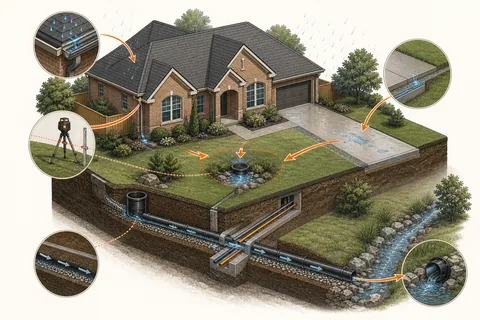
Use this property drainage assessment checklist to prepare for a free DFW on-site visit and understand how observations become a drainage estimate.
Bring storm photos, mark the wet footprint and list every roof, hardscape and uphill source. During a property drainage assessment, verify elevations, utilities, access, soil behavior, existing pipes and the final discharge. A proposal should explain all four parts: source, collection, conveyance and outlet.
Reviewed September 14, 2026 · Dallas–Fort Worth homeowner guide
Homeowner preparation
Evidence collected during rain is unusually valuable
Photograph the first water movement, not only the final puddle. Include wide views showing the house, neighboring grade, fences and hardscape. Note rainfall timing, how long water remains and whether the area is wet without rain.
Prepare a short history: previous drainage work, foundation or landscaping changes, irrigation repairs and known buried lines. This keeps the visit focused on causes instead of appearances.
Step one
Inventory every water source
Check each downspout, roof valley, patio, driveway, pool deck, air-conditioning drain, irrigation zone and uphill boundary. Estimate the area feeding the problem and observe whether flow is concentrated or spread across the surface.
When water approaches the foundation, review the water-near-foundation guide. Drainage work is not a substitute for structural or plumbing evaluation when those issues are suspected.
Step two
Measure elevation, distance and constructability
Use a laser, builder’s level or careful string measurement to compare the collection elevation with the proposed outlet. Calculate required fall across the whole route. Confirm trench depth, fence openings, equipment access, roots, concrete crossings and restoration areas.
The guide on calculating yard slope explains rise over run. If gravity cannot maintain fall, evaluate a designed outdoor pump rather than hiding a belly in the pipe.
Step three
Inspect existing systems and locate conflicts
Open accessible grates and cleanouts. Record pipe material, diameter, direction, visible silt, root intrusion and outlet condition. A blocked outlet can make upstream components look undersized.
Contact Texas 811 before excavation. Also identify private irrigation, low-voltage lighting, pool equipment and private electrical. Fort Worth notes that private-lot grading and drainage must avoid adverse impacts; other municipalities have their own requirements.
A clear proposal
What an assessment should produce
| Proposal item | What it should explain |
|---|---|
| Diagnosis | Observed source and pathway |
| Collection | Why an inlet, grade change or subsurface collector fits |
| Route | Material, diameter, length, fall, access and cleanouts |
| Outlet | Where water ends and how erosion or backup is controlled |
| Exclusions | Utilities, permits, hidden conditions and restoration limits |
Ask for a sketch and itemized assumptions. If the outlet is described only as “away from the house,” the route is not complete. The free property drainage assessment page explains how to request an eligible DFW visit.
Sources and further reading
- City of Fort Worth — Private Lot Drainage Review
- City of Dallas — Drainage Design Standards
- USDA NRCS — Web Soil Survey
- Texas 811 — Before You Dig
External sources support homeowner education and do not imply endorsement of Texas Yard Drainage. This guide is general information, not an engineering report or a property-specific design.
Continue the topic
Related drainage guides and problem pages
Homeowner FAQ
Questions this guide should answer
These answers help with early diagnosis. Actual recommendations still depend on the property.
What should I do before a drainage estimate?
Collect rain photos, note recovery time, list previous work and identify known irrigation or utility routes.
Does a contractor need to measure elevations?
A reliable gravity plan requires elevation comparison between collection points, route and outlet.
Who locates utilities before digging?
Texas 811 coordinates participating public utility markings. Private facilities may require a separate locator.
What should a proposal include?
Diagnosis, collection method, route, outlet, materials, restoration, exclusions and price assumptions.
Can an assessment guarantee no future standing water?
No responsible assessment can guarantee performance in every storm or unknown condition. Assumptions should be explicit.
Is the Texas Yard Drainage assessment free?
The initial on-site assessment is free for eligible residential addresses within the current Dallas–Fort Worth service route. Engineering, surveying and specialty inspections are separate.
Need a property-specific answer?
Request a free assessment built around the complete route.
Share the ZIP code, drainage symptom and rain photos for an eligible Dallas–Fort Worth property.
Request a Free Assessment