Elevation and gravity
How to Calculate Yard Slope for Drainage
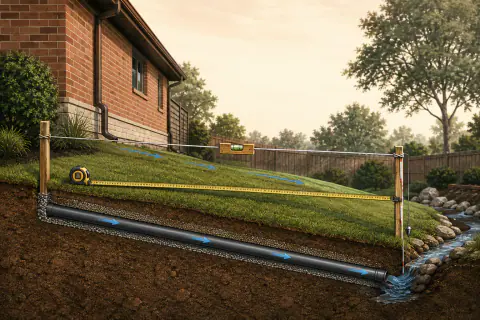
Yard slope is the vertical rise or fall divided by the horizontal run, multiplied by 100. Measuring it helps determine whether water can move continuously toward a usable outlet.
Use slope percent = vertical fall ÷ horizontal run × 100. If a route falls 1 foot over 100 horizontal feet, the slope is 1%. A positive calculation is only the beginning: confirm the entire route, pipe depth, obstructions and the final outlet before designing drainage.
Reviewed September 9, 2026 · Dallas–Fort Worth homeowner guide
Rise over run
The yard-slope formula is vertical change divided by horizontal distance.
Use the same units for both measurements. A 12-inch fall over a 100-foot run becomes 1 foot divided by 100 feet, or 1%. A 6-inch fall over 50 feet is also 1%. NRCS defines slope percent using the same rise-over-run calculation.
For quick conversion, 1% is approximately 1/8 inch of fall per foot; 2% is approximately 1/4 inch per foot. Small measurement errors accumulate over a long route, so a professional laser or survey level is more dependable when the available fall is tight.
String-level method
How to measure approximate yard slope with two stakes
- Choose the route. Start at the proposed collection point and end at the proposed outlet, not simply at the property edge.
- Set two reference points. Place one stake at each end where it is safe to do so.
- Level the string. Tie string near ground level at the high stake, stretch it to the lower stake and adjust the far end until the string is level.
- Measure horizontal run. Measure the straight horizontal distance between the stakes.
- Measure vertical fall. At the lower stake, measure from the level string down to the ground or selected outlet elevation.
- Calculate percent slope. Convert both values to the same unit, divide fall by run and multiply by 100.
- Repeat at grade changes. A positive average can hide a reverse section, hump or low point that interrupts flow.
A laser level makes it easier to check multiple points. For complex grading, drainage easements, commercial work or disputed elevations, use an appropriately qualified survey or engineering professional.
Worked examples
Simple slope calculations for drainage planning
| Vertical fall | Horizontal run | Calculated slope | Early interpretation |
|---|---|---|---|
| 3 inches | 25 feet | 1% | Gentle fall; verify every intermediate point |
| 6 inches | 50 feet | 1% | Same percentage over a longer route |
| 12 inches | 50 feet | 2% | More fall, but outlet and erosion still matter |
| 3 inches | 60 feet | 0.42% | Very limited fall; construction tolerances become important |
| -2 inches | 40 feet | -0.42% | Proposed outlet is higher; gravity route does not work as measured |
These examples are math, not universal design minimums. Surface grades, swales, solid pipe and perforated collection systems have different constraints. Local criteria, pipe diameter, surface tolerance, sediment, access and outlet conditions can require another approach.
Average is not enough
A drainage line needs continuous usable fall along the entire route.
Suppose the end point is 12 inches lower than the start. A raised patio edge halfway between them can still block surface water. A buried utility may force the pipe deeper and use the available fall. A curb or discharge point may sit above the pipe invert even though the lawn surface appears lower.
Measure the collection elevation, intermediate high and low points, trench depth, pipe connections and outlet elevation. Then consider restoration: a grate must finish at the surface low point, and a daylight outlet must remain exposed, stable and serviceable.
Do not excavate a long trench and hope an outlet appears. Confirm the receiving location, ownership, elevation and local requirements before finalizing the route.
Avoid false confidence
Common yard-slope measurement mistakes
- Measuring along the ground instead of using horizontal run.
- Using a stretched or sagging line as the level reference.
- Calculating only the average and missing a reverse-grade segment.
- Measuring lawn surface while ignoring the required pipe depth and fittings.
- Treating the street or neighbor as an automatic legal outlet.
- Ignoring settlement, roots, concrete edges and utility conflicts.
- Assuming a phone app is survey-grade without verification.
Before digging, request utility location through Texas 811. Fort Worth also notes that private lot-to-lot drainage concerns are generally private matters and that private improvements should not create adverse impacts. Other DFW cities may have different rules, so confirm the applicable jurisdiction.
From measurement to solution
How slope affects the drainage method
With dependable fall, grading or a drainage swale may restore a surface path. A low point can feed a catch basin and solid pipe. Roof water can travel through underground downspout drainage. Subsurface water may be collected by a French drain when the trench and outlet fit.
If there is no workable gravity outlet, an outdoor sump pump may be considered. The pump route still needs a lawful discharge, controls, maintenance access and a plan for power loss or failure.
Sources and further reading
- USDA NRCS — Soil Survey Manual, Slope Gradient Definition
- Penn State Extension — Lawn Establishment and Grade Away from Foundations
- City of Fort Worth — Private Lot Drainage and Grading
- City of Fort Worth — Drainage Runoff FAQ
- Texas 811 — Utility Location Before Digging
External sources support homeowner education and do not imply endorsement of Texas Yard Drainage. This guide is general information, not an engineering report or a property-specific design.
Continue the topic
Related drainage guides and problem pages
Homeowner FAQ
Questions this guide should answer
These answers help with early diagnosis. Actual recommendations still depend on the property.
How do I calculate a 1% slope?
Divide vertical fall by horizontal run and multiply by 100. One foot of fall over 100 horizontal feet is 1%; six inches over 50 feet is also 1%.
How many inches per foot is a 1% slope?
A 1% slope is 0.12 inch per foot, commonly approximated as 1/8 inch per foot.
Can I use a phone level to measure yard slope?
A phone can help with a rough screening, but it is not a substitute for a string level, laser level or survey equipment when available fall is small.
Why can a pipe hold water even when the yard slopes?
The pipe invert may not follow the lawn surface. Deep connections, fittings, settlement, utility conflicts or a high outlet can create a flat or reverse section.
What if my outlet is higher than the wet area?
The measured gravity route will not drain uphill. Evaluate another route, limited regrading or a properly designed pumped system instead of forcing a flat pipe.
Need a property-specific answer?
Confirm the route before choosing the drain.
See how grading, low-point collection and a verified outlet are evaluated for a Dallas–Fort Worth yard.
Explore Grading and Swales