Follow the water path
How Runoff and Infiltration Work in a Dallas–Fort Worth Yard
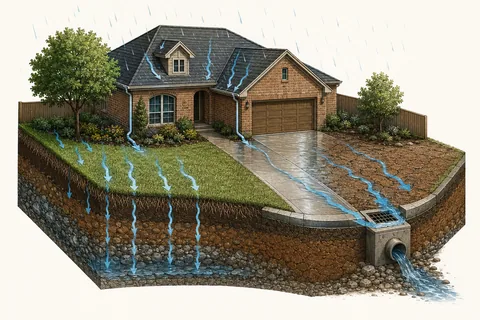
Runoff moves across the ground when rainfall arrives faster than the surface can absorb it; infiltration is water entering and moving through soil. DFW drainage problems often involve both processes.
A yard ponds when incoming water exceeds the combined capacity of infiltration, surface storage and the available outlet. The practical fix is not automatically more pipe: identify the sources, measure the route, determine what the soil can accept and verify a stable discharge point.
Reviewed September 9, 2026 · Dallas–Fort Worth homeowner guide
The basic water balance
Why some rain soaks in while the rest becomes runoff
Rain falling on a property can be intercepted by plants, enter the soil, collect temporarily in low areas or leave as runoff. The U.S. Geological Survey describes infiltration as water entering the ground; the rate changes with soil texture, saturation, vegetation, compaction and rainfall intensity.
When a North Texas storm delivers water faster than the surface can accept it, the excess follows gravity. Roofs, driveways and patios contribute quickly because they store very little water. A downspout can concentrate runoff from hundreds of square feet of roof into one small discharge point.
Source + rate + surface path + soil recovery + outlet determine the visible symptom. A product name alone does not explain the water balance.
Local context
Clay-rich soil can accept water slowly and recover unevenly
Much of the Dallas–Fort Worth area has fine-textured, shrink-swell soil. Dry cracks may accept initial rain, then close as clay wets. Compacted construction fill, narrow side yards and mixed soil layers can create a faster surface route above a slower subsurface zone.
This is why a yard may show rapid runoff during the storm and remain soft afterward. Read the companion guide on how soil affects yard drainage before assuming every wet area needs the same trench.
Storm evidence
Document the sequence, not only the final puddle
Start photos or video when rain begins. Record downspouts, neighboring elevations, fence gaps, hardscape edges and the first location where water concentrates. Repeat the observation when rain stops, then note recovery after several hours and the next day.
| Observation | Likely question |
|---|---|
| Fast sheet flow during rain | Can grade, a swale or a surface inlet intercept it? |
| Pond at one low point | Is the inlet elevation actually below the surrounding surface? |
| Soft soil after visible flow ends | Is slow infiltration or subsurface movement involved? |
| Water beside a downspout | Can concentrated roof water be carried in solid pipe? |
Diagnosis before product
Match the collection method to the pathway
Grading and swales guide shallow surface flow. Catch basins collect water at verified low points. Solid downspout pipe contains concentrated roof water. A French drain creates a permeable collection zone for water moving through saturated soil.
These components can work together, but every route needs capacity, continuous fall or a designed pump, service access and a stable outlet. Connecting sources without confirming the downstream route can simply move the backup.
Property-specific limits
Infiltration is not unlimited storage
An infiltration feature depends on tested soil behavior, separation from structures and utilities, available storage and recovery between storms. A clay yard or compacted commercial site may not accept water at the rate assumed from a generic chart.
Do not discharge onto a neighboring property, create erosion or connect to public infrastructure without authorization. Local requirements vary. Before excavation, contact Texas 811 and arrange separate location of private lines when needed.
Sources and further reading
- USGS Water Science School — Infiltration and the Water Cycle
- EPA — Urbanization and Stormwater Runoff
- USDA NRCS — Web Soil Survey
- Texas 811 — Before You Dig
External sources support homeowner education and do not imply endorsement of Texas Yard Drainage. This guide is general information, not an engineering report or a property-specific design.
Continue the topic
Related drainage guides and problem pages
Homeowner FAQ
Questions this guide should answer
These answers help with early diagnosis. Actual recommendations still depend on the property.
What causes runoff in a yard?
Runoff begins when rainfall or concentrated discharge exceeds infiltration and temporary surface storage. Slope and hard surfaces then direct the excess.
Does clay soil stop all infiltration?
No. Clay accepts water, but commonly at a slower and more variable rate than sandy soil, especially after wetting or compaction.
Can a French drain absorb unlimited rainwater?
No. It is a collection and conveyance assembly, not unlimited storage. It needs a usable outlet and adequate capacity.
Why does my yard stay wet after rain stops?
Possible reasons include slow soil recovery, a low grade, subsurface movement, irrigation, a leak or an outlet that holds water.
What should I photograph for an assessment?
Capture the first visible flow, all nearby sources, the wet-area edge, the path toward the low point and conditions after rainfall ends.
Need a property-specific answer?
Turn storm observations into a complete drainage route.
Texas Yard Drainage evaluates the source, collection point, route and outlet for Dallas–Fort Worth properties.
Request a Yard Drainage Assessment