Source to outlet
Residential Yard Drainage System Guide for Dallas–Fort Worth Homes
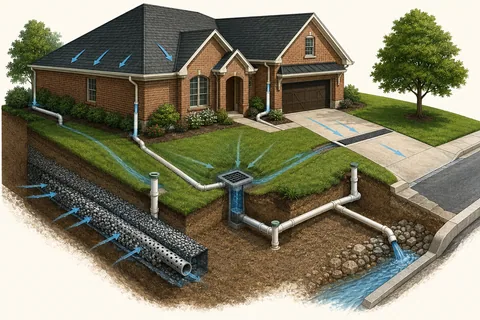
A residential drainage system works as a connected route: control the source, collect the right water pathway, convey it with suitable pipe or grade and discharge it safely.
The best system depends on how water arrives. Use solid pipe for concentrated roof water, surface inlets for visible low points, channel drains across hardscape flow, grading for shallow runoff and a gravel-wrapped perforated collector for subsurface saturation. Every component still needs a maintainable route and outlet.
Reviewed September 9, 2026 · Dallas–Fort Worth homeowner guide
One connected route
Every system needs source, collection, conveyance and outlet
Start by identifying roof runoff, uphill surface flow, saturated soil or hardscape sheet flow. Next choose a collection method that the water can physically reach. The route must then carry the expected flow without low sections, and the outlet must release it without erosion, backup or adverse impact.
This framework prevents a common mistake: buying a product first and searching for a problem it might solve. Read why drainage matters for the complete source-to-outlet model.
Residential components
What each system is designed to do
| Component | Best-fit role |
|---|---|
| Downspout extension | Contains concentrated roof runoff in solid pipe |
| Catch basin | Collects visible water at a verified surface low point |
| Channel drain | Intercepts sheet flow across a driveway, patio or walkway |
| French drain | Intercepts water moving through saturated soil |
| Swale or grading | Shapes a broad, shallow surface route |
| Outdoor sump pump | Lifts collected water when a dependable gravity outlet is unavailable |
Compare the dedicated pages for catch basins, channel drains and French drains before combining components.
Do not mix functions
Solid pipe and perforated pipe serve different water pathways
Solid pipe conveys captured water without intentionally releasing it into surrounding soil. It is typically used downstream of downspouts, basins and channel drains. Perforated pipe admits water through openings and belongs in a designed aggregate-and-fabric collection zone.
Sending roof water into perforated pipe beside a foundation can discharge concentrated water into already sensitive soil. Likewise, solid pipe buried in a wet strip does not collect distributed subsurface water unless inlets are provided.
Coordinated layouts
Examples of systems that can work together
- Roof + low lawn: separate solid downspout connections and a surface basin can join a correctly sized downstream solid route.
- Wet side yard: contain roof sources first; add a subsurface collector only where field evidence supports it.
- Driveway toward garage: place a load-appropriate channel drain across the flow and connect it to a verified outlet.
- No gravity fall: collect water in a serviceable basin and evaluate a pump with protected power and discharge.
Do not automatically combine sanitary, foundation, roof and surface systems. Existing connections, ownership and local requirements must be confirmed.
Keep the route visible
Inspection and maintenance protect capacity
Clean grates, remove leaves, inspect downspout connections and confirm visible discharge before storm season. Flush accessible lines only when the outlet is open. Look for settlement, crushed pipe, root intrusion, separated fittings and erosion.
A good layout includes cleanouts and a visible or verifiable outlet. If repeated backups occur, use the drain cleaning and repair checklist instead of adding another inlet upstream.
Sources and further reading
- EPA — Types of Green Infrastructure
- USGS — Infiltration and the Water Cycle
- City of Fort Worth — Private Lot Drainage Review
- Texas 811 — Before You Dig
External sources support homeowner education and do not imply endorsement of Texas Yard Drainage. This guide is general information, not an engineering report or a property-specific design.
Continue the topic
Related drainage guides and problem pages
Homeowner FAQ
Questions this guide should answer
These answers help with early diagnosis. Actual recommendations still depend on the property.
What is the best yard drainage system?
There is no universal best system. The correct choice depends on the source, water pathway, elevations, capacity and outlet.
Can catch basins and French drains connect?
They can be coordinated in some designs, but surface and subsurface collection roles, pipe type and downstream capacity must remain clear.
Should downspouts connect to perforated pipe?
Concentrated roof water is generally conveyed in solid pipe so it is not intentionally released into nearby soil.
What if my yard has no downhill outlet?
A properly designed outdoor sump system may lift collected water, subject to safe power, discharge and maintenance.
How often should drains be checked?
Inspect grates, connections and outlets seasonally and after major storms; clean when debris or reduced flow is visible.
Need a property-specific answer?
Match the residential system to the actual water pathway.
Explore assessment-first yard drainage services for homes across Dallas–Fort Worth.
Explore Residential Drainage