Soil and water
How Soil Affects Yard Drainage in North Texas
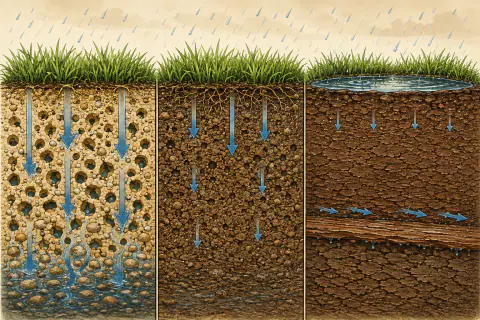
Soil texture, pore space, compaction and layering affect how quickly rain enters the ground, how long it is stored and whether water moves downward, sideways or back to the surface.
Sandy soil usually transmits water through larger pores more quickly, while fine-textured clay soil tends to move water more slowly and can remain wet longer. Real yards are layered and disturbed, so texture is only one part of drainage diagnosis; grade, water source and outlet remain essential.
Reviewed September 9, 2026 · Dallas–Fort Worth homeowner guide
Texture controls pore size
Sand, silt and clay affect how water enters, stores and moves through soil.
USDA soil texture is based on the relative proportions of sand, silt and clay. Sand particles are the largest of the three, silt is intermediate and clay is the smallest. Particle size influences the size and continuity of pores—the spaces that can hold air and water.
| Fraction | USDA particle size | General water behavior |
|---|---|---|
| Sand | 0.05 to 2.0 mm | Larger pores; often faster infiltration and drainage when not compacted |
| Silt | 0.002 to 0.05 mm | Intermediate particles; behavior depends strongly on structure and compaction |
| Clay | Less than 0.002 mm | Very small particles and pores; typically slower movement and higher water retention |
These are general tendencies, not a property diagnosis. Organic matter, roots, aggregation, cracks, construction disturbance and underlying layers can make two soils with similar texture behave differently.
Local relevance
Clay-rich soil can extend ponding, but it does not prove which drainage system is needed.
Parts of Dallas–Fort Worth have fine-textured soils that accept water slowly when wet or compacted. During dry periods, some clay-rich soils develop cracks that temporarily accept water, then swell and close as moisture increases. A yard can therefore behave differently at the start of a storm than it does after hours of rain.
Clay is often blamed for every wet-yard symptom, but the highest-volume source may still be a roof, driveway or neighboring grade. If runoff arrives faster than the surface can infiltrate, the first priority may be contained downspout drainage, a surface inlet or a restored grade—not a subsurface trench.
For a shorter regional overview, see North Texas clay soil and yard drainage.
Real yards are layered
Compaction and soil interfaces can matter as much as texture.
Construction traffic, repeated foot traffic and equipment can compress pore space. Imported topsoil may sit over denser subsoil or fill. A trench may cut through one layer and stop at another. Water can perch above a slowly permeable layer and move sideways even when the surface material appears acceptable.
This is why a single handful of soil cannot describe the full profile. A shallow sample may represent sod soil, while the drainage route passes through compacted fill at a different depth. Observe excavations or test holes where permitted, and note changes in color, structure, roots, gravel or construction debris.
USDA Web Soil Survey is useful regional context. Site grading, imported fill and construction disturbance can differ from the mapped native soil, so field conditions and elevations still control the recommendation.
Simple field checks
Use several observations instead of one “clay test.”
- Watch a storm. Mark whether water runs over the surface or the ground simply becomes soft.
- Try the ribbon test. A moist sample that forms a longer cohesive ribbon suggests more clay-like behavior; a crumbly sample suggests a coarser texture.
- Check infiltration carefully. A small test hole can show whether water enters quickly or remains, but antecedent moisture and disturbed soil affect the result.
- Compare locations. Test the wet area and a nearby area that drains normally.
- Check non-rain sources. Irrigation, leaks, pool equipment and air-conditioning discharge can imitate stormwater saturation.
Follow the full step-by-step soil ribbon test guide and treat the result as a screening observation, not a laboratory classification.
Design implications
Soil changes how a drainage system should be selected and built.
Surface collection
Where clay-rich ground cannot accept intense runoff quickly, a correctly placed basin can collect visible ponding and move it through solid pipe.
Subsurface collection
A French drain needs permeable fabric, clean aggregate, an appropriate perforated pipe and a verified outlet. Fine sediment and incorrect fabric or aggregate can reduce performance.
Grading
Grading and swales must remain stable. Bare fine-textured soil can erode when concentrated, so vegetation or another stabilized surface may be part of the route.
Restoration
Excavated clay can be difficult to replace uniformly when too wet or too dry. Backfill, surface contour and turf restoration affect whether new depressions develop.
The final design should still begin with the water source and end at the outlet. Soil explains how the route may behave; it does not create elevation or authorize a discharge point.
A better homeowner question
Ask “how is water moving through this soil profile?” rather than only “do I have clay?”
That question leads to useful evidence: texture, compaction, layers, surface fall, saturation depth and recovery time. It also prevents a common shortcut—selling a standard trench because the region is associated with clay.
- Separate incoming volume from the ability of soil to absorb it.
- Compare wet and normal parts of the same yard.
- Check grade and outlet before sizing a buried route.
- Protect any discharge against erosion.
- Call Texas 811 before excavation and verify local requirements.
Sources and further reading
- USDA NRCS — Soil Texture Calculator and Texture Triangle
- USDA NRCS — Guide to Texture by Feel
- USDA NRCS — Web Soil Survey
- U.S. Geological Survey — Infiltration and the Water Cycle
- U.S. EPA — Urbanization and Stormwater Runoff
External sources support homeowner education and do not imply endorsement of Texas Yard Drainage. This guide is general information, not an engineering report or a property-specific design.
Continue the topic
Related drainage guides and problem pages
Homeowner FAQ
Questions this guide should answer
These answers help with early diagnosis. Actual recommendations still depend on the property.
Why does clay soil drain slowly?
Clay particles are extremely small and tend to create small pores. Water movement is often slower and water retention higher than in coarse sandy soil, though structure, cracks and compaction can change field behavior.
Does clay soil always need a French drain?
No. The dominant problem may be roof runoff, a low surface grade, a blocked outlet or irrigation. A French drain is appropriate only when subsurface collection and a workable outlet address the observed pathway.
Can I improve clay drainage by adding sand?
Adding a small amount of sand to clay is not a universal fix and may not create a useful soil structure. Surface routing, organic matter for planting areas and property-specific drainage work should be evaluated separately.
Is USDA Web Soil Survey accurate for my exact yard?
It is valuable regional mapping, but a residential lot may contain imported fill, compacted subsoil and construction disturbance that differ from the mapped native soil.
What soil test can I do at home?
A ribbon test offers a quick texture estimate. Compare it with storm observations, a cautious infiltration check and the actual soil profile before drawing drainage conclusions.
Need a property-specific answer?
Use soil evidence to choose the right collection method.
See how French drains collect subsurface water when the trench, pipe, fall and outlet fit the property.
Explore French Drain Installation