Diagnosis before product
Surface Water vs. Subsurface Water: How to Tell What Is Making Your Yard Wet
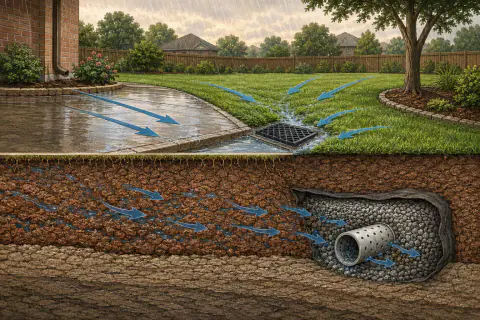
Surface water travels over the yard during rain; subsurface water moves through pores and saturated layers below the surface. The timing, direction and location of wetness help separate them.
If you can see water arriving across grass, concrete or from a downspout during rain, start by investigating surface runoff. If the ground becomes soft from below, remains wet after surface flow ends or seeps from a slope, investigate subsurface saturation. Many properties have both, so the complete route still matters.
Reviewed September 9, 2026 · Dallas–Fort Worth homeowner guide
Two different pathways
Surface water and subsurface water are separated by where the water is moving.
Surface water
Rainfall or discharge that flows over grass, soil, concrete or another visible surface. It often responds quickly to a storm and follows low contours.
Subsurface water
Water stored or moving within soil pores, fill, gravel seams or layers below grade. It may appear as seepage, prolonged softness or a saturated trench.
The distinction is important because a surface inlet only collects water that can reach its grate, while a subsurface trench is intended to intercept water moving through the surrounding aggregate and soil. Installing the wrong collection method can leave the dominant pathway unchanged.
Observe the timing
How a homeowner can tell which pathway is more likely
| Observation | More consistent with | What to inspect next |
|---|---|---|
| Water races across the lawn during heavy rain | Surface runoff | Upstream grade, hard surfaces, fence openings and low points |
| A downspout empties beside the wet area | Concentrated surface source | Roof area, connection, solid-pipe route and outlet |
| The surface looks calm but soil remains spongy for days | Subsurface saturation or poor recovery | Soil texture, compaction, irrigation, leaks and lower layers |
| Water seeps from the side of a slope or cut | Subsurface/layered flow | Uphill source, soil layers, seasonality and interception route |
| A puddle forms at one precise depression | Surface collection problem | True low elevation and a viable gravity outlet |
No single clue is absolute. A lawn may receive rapid surface runoff, then remain wet because the fine-textured soil accepts and transmits water slowly. Take photos during the storm and again after visible runoff stops.
Visible runoff
Surface-water solutions collect or reshape the visible flow path
A catch basin belongs at a real surface low point where water can enter the grate. A channel drain belongs across a predictable sheet-flow line, such as a driveway approaching a garage. Grading or a swale can spread and guide shallow flow when there is space and a stable destination.
Roof runoff is also a surface source, but it is highly concentrated. Solid underground downspout pipe is normally used to convey that water. Perforated pipe beside the foundation can release roof water into the soil it was supposed to protect.
A grate installed near a puddle is not necessarily at the puddle elevation. Even a small high spot around the basin can prevent water from reaching it.
Water in soil
Subsurface solutions intercept water only when the trench and outlet work together
A French drain uses permeable fabric, clean aggregate and perforated pipe to create a collection zone for water moving through saturated soil. It still needs a continuous route to a lower outlet. The trench should not be treated as unlimited storage, and the pipe should not be expected to pull water uphill.
Subsurface wetness can also result from irrigation, a plumbing leak, pool equipment, air-conditioning discharge or a buried line. If the area stays wet without rain, review the wet yard without rain checklist before assuming stormwater is the source.
Mixed conditions
Many Dallas–Fort Worth yards have both surface runoff and saturated soil.
A narrow side yard can receive two roof planes, runoff from a higher backyard and slow recovery in compacted soil. The correct plan may separate sources: contain the downspouts in solid pipe, collect the surface low point, and use a subsurface trench only where soil water is actually moving. Combining every component into one perforated line can mix clean roof water with saturated-soil collection and reduce control.
Where a property has almost no usable fall, confirm elevations before designing. If gravity is not dependable, outdoor sump pumping may be considered with service access, safe power, check-valve/backflow control and a protected discharge.
Avoid the shortcut
Do not diagnose by the appearance of one dry-day photograph
The same brown or muddy patch can result from multiple pathways. Useful evidence includes the first place water appears, upstream contributors, the edge of the wet footprint, recovery time and the outlet elevation. A site visit should connect those observations to measured grade and accessible utilities.
- Trace roof water separately from yard runoff.
- Mark the visible flow direction during rain.
- Check whether an inlet is actually lower than the surrounding surface.
- Look for seepage from cuts, retaining edges or slopes.
- Verify the outlet before choosing pipe or trench depth.
Sources and further reading
- U.S. Geological Survey — Infiltration and the Water Cycle
- U.S. Geological Survey — Surface Runoff and the Water Cycle
- U.S. Geological Survey — Groundwater/Surface-Water Interaction
- U.S. EPA — Urbanization and Stormwater Runoff
- City of Fort Worth — Stormwater Management
External sources support homeowner education and do not imply endorsement of Texas Yard Drainage. This guide is general information, not an engineering report or a property-specific design.
Continue the topic
Related drainage guides and problem pages
Homeowner FAQ
Questions this guide should answer
These answers help with early diagnosis. Actual recommendations still depend on the property.
What is the difference between surface water and groundwater?
Surface water is visible runoff or ponding on the ground. Groundwater is water below the water table; homeowners may also encounter shallower subsurface saturation or perched water that is not the regional water table.
How do I know if my yard has subsurface water?
Clues include prolonged softness after runoff ends, seepage from a slope, or water entering a test hole from the side. Irrigation and plumbing sources should also be ruled out.
Will a catch basin fix saturated soil?
A catch basin can remove water that reaches the surface low point. It does not directly collect water distributed through saturated soil unless that water emerges at the basin.
Will a French drain collect surface water?
Some surface water may enter the gravel, but a French drain is primarily a subsurface collector. Fast visible runoff is usually handled more directly with grade, inlets or linear drains.
Can one system handle both types of water?
A coordinated design can address both, but the sources may need separate collection components and sometimes separate pipe types before they share an appropriate downstream route.
Need a property-specific answer?
Match the collection method to the way water moves.
Compare surface collection, solid conveyance, subsurface drainage and grading before selecting a system.
Compare Drainage Services