Homeowner field check
How to Identify Clay Soil with a Simple Ribbon Test
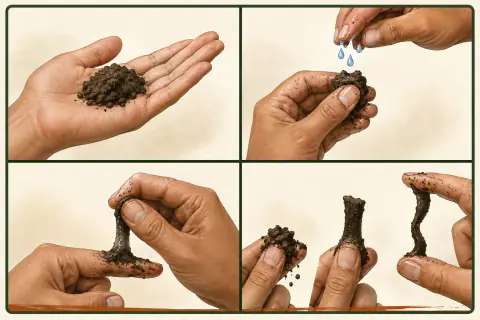
The soil ribbon test estimates texture by moistening a sample, kneading it into a smooth putty and pressing it between the thumb and forefinger to see whether it forms a stable ribbon.
A sample that will not form a ribbon is generally sandier; a short weak ribbon suggests loamier soil; a longer, stronger ribbon suggests more clay-like texture. The test is a field estimate, not a laboratory result, and it does not identify the correct drainage system by itself.
Reviewed September 9, 2026 · Dallas–Fort Worth homeowner guide
Texture by feel
The ribbon test estimates the balance of sand, silt and clay from the way moist soil behaves.
USDA NRCS uses texture-by-feel procedures as a practical field method. The key is not simply whether soil feels sticky. The sample is brought to a consistent moist, moldable condition, then its ability to form a ribbon and its grittiness or smoothness are observed together.
For a homeowner, the result is best used as a screening clue. A clay-like sample may help explain slow infiltration or long recovery after rain. It does not prove that a French drain is needed, because water may still be arriving from a downspout, surface grade, irrigation or another source.
Five practical steps
How to perform a soil ribbon test
- Collect a representative sample. Remove grass, mulch, roots and obvious gravel. Take soil from the depth relevant to the wet condition, not only loose potting soil at the surface.
- Break down the sample. Place roughly a small handful in the palm and crush dry aggregates so the sample is reasonably uniform.
- Add water slowly. Add drops and knead until the soil is moist and plastic, similar to workable putty. If it shines, smears excessively or sticks as wet mud, mix in a little dry soil and try again.
- Form the ribbon. Hold a ball of soil between thumb and forefinger. Press upward with the thumb so a flat ribbon extends over the finger under its own weight.
- Observe the break. Estimate the ribbon length when it breaks, then rub a pinch between fingers to notice whether it feels predominantly gritty, smooth/floury or sticky.
Try at least two samples from the wet area and one from a nearby area that recovers normally. Residential fill and subsoil can change over a short distance.
Interpret cautiously
What ribbon behavior generally suggests
| Field behavior | General interpretation | Drainage implication to investigate |
|---|---|---|
| Will not form a stable ribbon; very gritty | Sandier or loamy-sand tendency | Look closely for compaction, buried layers or an unusually large incoming water source |
| Weak ribbon that breaks quickly | Loam or silt-loam tendency | Compare structure and infiltration between wet and normal areas |
| Moderate cohesive ribbon | Clay-loam tendency | Slow recovery may combine with grade, compaction or layered flow |
| Long, strong and sticky ribbon | Higher clay tendency | Surface collection or subsurface interception may be evaluated after source and outlet checks |
Exact classification requires the full texture-by-feel decision process or laboratory particle-size analysis. Moisture condition and technique can change the apparent ribbon length, so avoid turning one number into a definitive soil label.
What the test cannot answer
A ribbon result does not measure slope, flow volume or outlet elevation.
- It does not show how much roof or driveway runoff reaches the area.
- It does not identify a plumbing or irrigation leak.
- It does not reveal every buried layer below the sample depth.
- It does not calculate infiltration rate or seasonal groundwater.
- It does not prove that a specific drain will work.
- It does not replace utility location, municipal requirements or site measurements.
USDA Web Soil Survey can add regional context, while a site profile, rain observations and elevation measurements explain the actual property. Use all of them as evidence rather than relying on a single label.
Connect the result to the symptom
How to use the ribbon test in a drainage assessment
If the wet area produces a strong clay-like ribbon but nearby soil does not, construction fill or local compaction may be contributing. If every sample is clay-like but only the area below a downspout floods, the concentrated roof source may still be the priority. If the yard stays soft days after surface water disappears, investigate subsurface saturation and soil layering.
Visible ponding at a low point may call for a surface catch basin connected to a workable route. Water moving through saturated soil may justify a French drain. Broad flow may be addressed with grading or a swale. The ribbon test helps explain soil behavior; source, grade and outlet select the system.
Safety and accuracy
Keep the test simple and avoid questionable samples.
Do not test soil suspected of contamination, sewage exposure, chemical treatment or sharp debris with bare hands. Wash hands after handling soil. Avoid digging near utilities; Texas 811 provides utility-location requests before excavation.
Record the date, recent rainfall, sample location and approximate depth. A result taken from bone-dry cracked soil in summer may not describe how the same profile behaves after several wet days.
Sources and further reading
- USDA NRCS — Guide to Texture by Feel
- USDA NRCS — Soil Texture Calculator
- USDA NRCS — Web Soil Survey
- U.S. Geological Survey — Infiltration and the Water Cycle
- Texas 811 — Every Dig Counts
External sources support homeowner education and do not imply endorsement of Texas Yard Drainage. This guide is general information, not an engineering report or a property-specific design.
Continue the topic
Related drainage guides and problem pages
Homeowner FAQ
Questions this guide should answer
These answers help with early diagnosis. Actual recommendations still depend on the property.
How long must a soil ribbon be to indicate clay?
Longer, stronger ribbons generally indicate more clay, but length alone is not a complete classification. Grittiness, smoothness, stickiness and the full NRCS texture-by-feel sequence also matter.
Why is my soil too sticky to test?
It may be too wet. Add a little dry soil and knead until the sample is plastic and moldable rather than shiny or soupy.
Can I use topsoil from under the sod?
You can, but it may not represent the compacted fill or subsoil where a drainage route would be installed. Compare more than one depth and location without digging near utilities.
Does a long ribbon mean I need a French drain?
No. It suggests clay-like texture. The correct solution still depends on whether the water is surface runoff or subsurface saturation and whether a lower outlet exists.
Is the ribbon test the same as a laboratory soil test?
No. It is a useful field estimate. Laboratory particle-size analysis provides a more controlled classification.
Need a property-specific answer?
A soil test is one clue—not the drainage plan.
See how a property assessment connects soil behavior with the water source, elevations and a usable outlet.
Request a Drainage Assessment