Drainage fundamentals
Why Is Yard Drainage Important for a Dallas–Fort Worth Home?
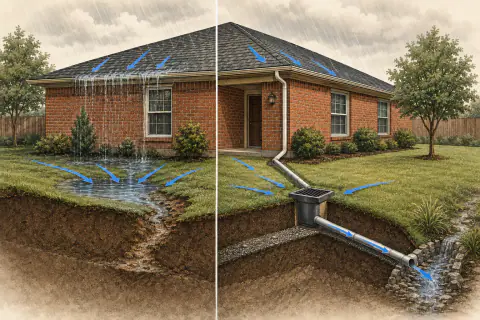
Yard drainage controls where roof runoff, surface flow and saturated-soil water go so they do not repeatedly collect beside the house, cross usable areas or erode the property.
Good yard drainage gives stormwater a complete route: identify the source, collect or redirect it, carry it with continuous fall, and release it at a stable, permitted outlet. It protects everyday use of the property and reduces avoidable water exposure, but the correct method depends on what the water is actually doing.
Reviewed September 9, 2026 · Dallas–Fort Worth homeowner guide
The practical purpose
Yard drainage is important because water keeps following elevation—even when the route is inconvenient.
Rain does not stop at the property line or disappear when it reaches grass. Water may run from a roof, driveway, patio, neighboring grade or higher part of the lot. Some enters the soil; some continues across the surface. When the intended path is flat, blocked or aimed toward a low area, the same spot can flood after every storm.
A useful drainage plan is not simply “install a drain.” It answers four connected questions: where the water starts, where it can be collected, how it can travel and where it may safely discharge. Missing any one of those parts can leave a basin full, a buried pipe holding water or a new erosion problem at the outlet.
Drainage work manages water around the property. It is not a structural foundation diagnosis, a flood-control guarantee or permission to send water onto a neighbor.
North Texas context
Why drainage problems are noticeable around Dallas–Fort Worth
Roofs, driveways and patios are impervious surfaces: rain that lands on them cannot soak in at that location, so it becomes concentrated runoff. Fort Worth describes this same basic pattern in its public stormwater guidance and notes that uncontrolled runoff can contribute to flooding, erosion and pollution. The exact effect on a home still depends on the storm, contributing area, grade, soil and outlet.
Fine-textured or compacted soil can extend the wet period because infiltration and internal movement may be slow. That does not mean every DFW property has identical clay or that every wet lawn needs a French drain. A short downspout, a landscape border that acts like a dam, a settled trench or a low driveway edge may be the dominant cause. Start with observation, not a product name.
Source to outlet
The four parts of a drainage route
Source
Roof runoff, overland flow, irrigation, a higher lot or water moving through saturated soil.
Collection
A downspout connection, true surface low point, linear interception drain, swale or subsurface trench.
Conveyance
Surface grade, solid pipe, perforated collection pipe or a pumped line selected for that water type.
Outlet
A lower, serviceable and stable discharge that does not create a new hazard or adverse impact.
The route is only as dependable as its weakest part. A large inlet connected to a flat pipe will still hold water. A pipe with good fall but no protected outlet can scour soil. Regrading one low spot without tracing the next low spot may simply move the puddle.
Match the method
Different water paths call for different drainage solutions
Visible surface runoff
A catch basin or surface drain can collect water at a true low point. Channel drains intercept a predictable sheet of water crossing a driveway, patio or threshold.
Concentrated roof water
Underground downspout drainage keeps roof runoff in solid pipe instead of asking a small patch of soil to absorb a large roof area.
Broad shallow flow
Grading and drainage swales may restore a stable surface route where usable fall and space exist.
Saturated soil
A correctly designed French drain collects water moving through a gravel trench. It is not automatically the answer to a fast surface puddle.
If gravity cannot reach a suitable lower outlet, an outdoor sump pump system may be evaluated. Pumping adds power, controls, backflow protection and maintenance, so it should follow—not replace—an elevation check.
When to investigate
Signs that the property needs a closer drainage assessment
- Standing water remains in the same lawn area after ordinary rain.
- A side yard stays soft or muddy long after adjacent areas recover.
- Downspouts discharge beside the slab or into trapped landscape beds.
- Runoff crosses a garage threshold, patio, walkway or gate.
- Mulch, soil or turf repeatedly washes away along one route.
- An existing inlet fills but drains slowly, or the outlet cannot be found.
- Water collects beside the foundation because the finish grade slopes inward.
These observations identify the symptom; they do not prove the final repair. If a drain once worked, begin with inspection and drainage repair before assuming the entire system needs replacement.
Homeowner decision
What a useful drainage proposal should explain
A proposal should connect the observed water to the recommended collection method, show the route, identify pipe type, describe fall and outlet conditions, and state restoration and exclusions. It should also explain what would cause the plan to change—unknown utilities, inaccessible elevations, buried structures, easements, permits or a discharge point that cannot be used.
Before any digging, request utility location through Texas 811. City requirements and private drainage rights can vary, and a private-lot solution should not create an adverse impact on another property.
Sources and further reading
- U.S. EPA — Urbanization and Stormwater Runoff
- U.S. Geological Survey — Surface Runoff and the Water Cycle
- City of Fort Worth — Stormwater Management
- City of Fort Worth — Private Lot Drainage and Grading
- Texas 811 — Utility Location Before Digging
External sources support homeowner education and do not imply endorsement of Texas Yard Drainage. This guide is general information, not an engineering report or a property-specific design.
Continue the topic
Related drainage guides and problem pages
Homeowner FAQ
Questions this guide should answer
These answers help with early diagnosis. Actual recommendations still depend on the property.
What is the main purpose of yard drainage?
The main purpose is to give unwanted water a controlled route from its source to a safe, stable outlet instead of allowing repeated ponding, erosion or flow toward vulnerable areas.
Does every wet yard need a French drain?
No. Fast surface runoff, roof discharge, a low spot, blocked grade or a failed existing drain may call for a surface inlet, solid pipe, grading, repair or another method.
Can yard drainage prevent all flooding?
No drainage system can guarantee protection from every storm or off-site condition. Capacity, maintenance, upstream flow and the available outlet all set practical limits.
Why is the outlet so important?
Collection only works when the water can leave. The outlet must be lower enough for the proposed route, accessible for maintenance, stable against erosion and appropriate under local and property rules.
When should I photograph a drainage problem?
Take wide and close photos while water is moving, then photograph the same area later. Include downspouts, hardscape, fence lines, inlets and the suspected outlet.
Need a property-specific answer?
Trace the water before choosing the system.
See the assessment-first service that connects the source, collection point, route and outlet for a Dallas–Fort Worth property.
Explore Yard Drainage Solutions