Plain-English reference
Yard Drainage Glossary: Pipes, Basins, Soil and Stormwater Terms
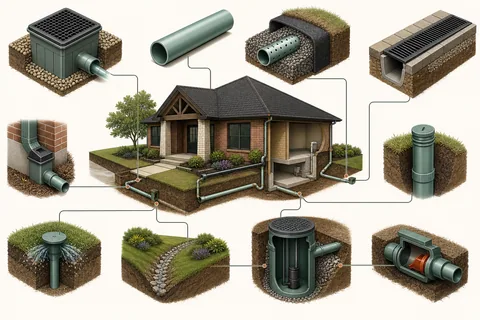
A practical glossary of residential and commercial drainage terms used across Dallas–Fort Worth, from catch basins and French drains to inverts, detention and hydraulic grade lines.
Drainage terms describe four parts of a system: the water source, collection method, conveyance route and final outlet. Use this glossary to compare proposals and ask what each component is expected to do on the property.
Reviewed September 9, 2026 · Dallas–Fort Worth homeowner guide
Water behavior
Terms describing how water reaches the problem area
- Runoff
- Water flowing over a surface after rainfall or discharge.
- Infiltration
- Water entering soil from the surface.
- Percolation
- Downward or lateral movement of water through soil after entry.
- Sheet flow
- Shallow runoff spread across a broad surface.
- Concentrated flow
- Runoff gathered into a channel, valley, downspout or narrow path.
- Hydrostatic pressure
- Pressure exerted by standing or confined water; diagnosis near structures may require a qualified specialist.
See Runoff and Infiltration for a visual explanation.
Collection components
Where water enters a drainage system
- Catch basin
- A grated surface inlet placed at a true low point.
- Area drain
- A general term for a point inlet serving a yard, patio or courtyard.
- Channel or trench drain
- A linear grate that intercepts sheet flow across hardscape.
- French drain
- A permeable trench containing clean aggregate, filter fabric and usually perforated pipe to collect subsurface water.
- Swale
- A broad, shallow graded channel that conveys surface runoff.
- Roof drain or downspout
- A component that concentrates roof runoff for controlled conveyance.
Conveyance and trench
Terms that define the underground route
- Solid pipe
- Non-perforated pipe used to carry captured water without intentionally releasing it into soil.
- Perforated pipe
- Pipe with openings that admit water inside a designed collection zone.
- Invert
- The inside-bottom elevation of a pipe or structure connection.
- Fall or grade
- Vertical drop along a route, often stated as percent slope.
- Bedding
- Prepared material supporting pipe and helping maintain alignment.
- Geotextile
- Permeable fabric used for separation and filtration in an appropriate assembly.
- Cleanout
- An accessible opening for inspection or maintenance.
Pipe type should follow the pathway explained in Surface Water vs. Subsurface Water.
Discharge and storage
Where water goes at the end of the route
- Daylight outlet
- A pipe opening at a stable lower ground elevation.
- Pop-up emitter
- A surface outlet whose lid rises under flow.
- Dry well
- An underground structure that stores water for infiltration; feasibility is site-specific.
- Detention
- Temporary storage with controlled release.
- Retention
- Storage that holds a permanent pool or relies on evaporation and infiltration.
- Overflow route
- A safe path for water when the primary system exceeds capacity.
- Sump basin
- A collection chamber from which a pump lifts water.
Compare these choices in Drainage Outlets and Discharge.
Planning and capacity
Terms that appear in professional drainage discussions
- Drainage area
- The surface contributing runoff to a selected point.
- Design storm
- A defined rainfall event used for planning or calculation under applicable criteria.
- Flow rate
- Volume of water moving per unit of time.
- Hydraulic grade line
- A representation of water energy or pressure level within a system.
- Freeboard
- Vertical safety margin above a design water level.
- Scour
- Erosion caused by concentrated or high-velocity flow.
- Backflow
- Reverse movement of water into a system.
- As-built
- A record of the installed location and elevations after construction.
Commercial design may require licensed engineering and municipal review; a glossary definition is not a sizing method.
Sources and further reading
- USGS — Infiltration and the Water Cycle
- EPA — Types of Green Infrastructure
- EPA — Storm Water Management Model
- City of Dallas — Drainage Design Standards
External sources support homeowner education and do not imply endorsement of Texas Yard Drainage. This guide is general information, not an engineering report or a property-specific design.
Continue the topic
Related drainage guides and problem pages
Homeowner FAQ
Questions this guide should answer
These answers help with early diagnosis. Actual recommendations still depend on the property.
What is the difference between a catch basin and French drain?
A catch basin collects visible surface water at a point; a French drain collects water through a permeable subsurface trench.
What does pipe invert mean?
It is the elevation at the inside bottom of the pipe, used to evaluate fall and connections.
What is the difference between solid and perforated pipe?
Solid pipe conveys captured water; perforated pipe admits water from a surrounding collection zone.
What is drainage detention?
Detention temporarily stores runoff and releases it at a controlled rate.
What does daylight mean in drainage?
It means a pipe opens at a lower ground surface where discharge can leave by gravity.
Need a property-specific answer?
Turn drainage terminology into a property-specific plan.
Explore services by water problem, system type and Dallas–Fort Worth location.
Browse Drainage Services